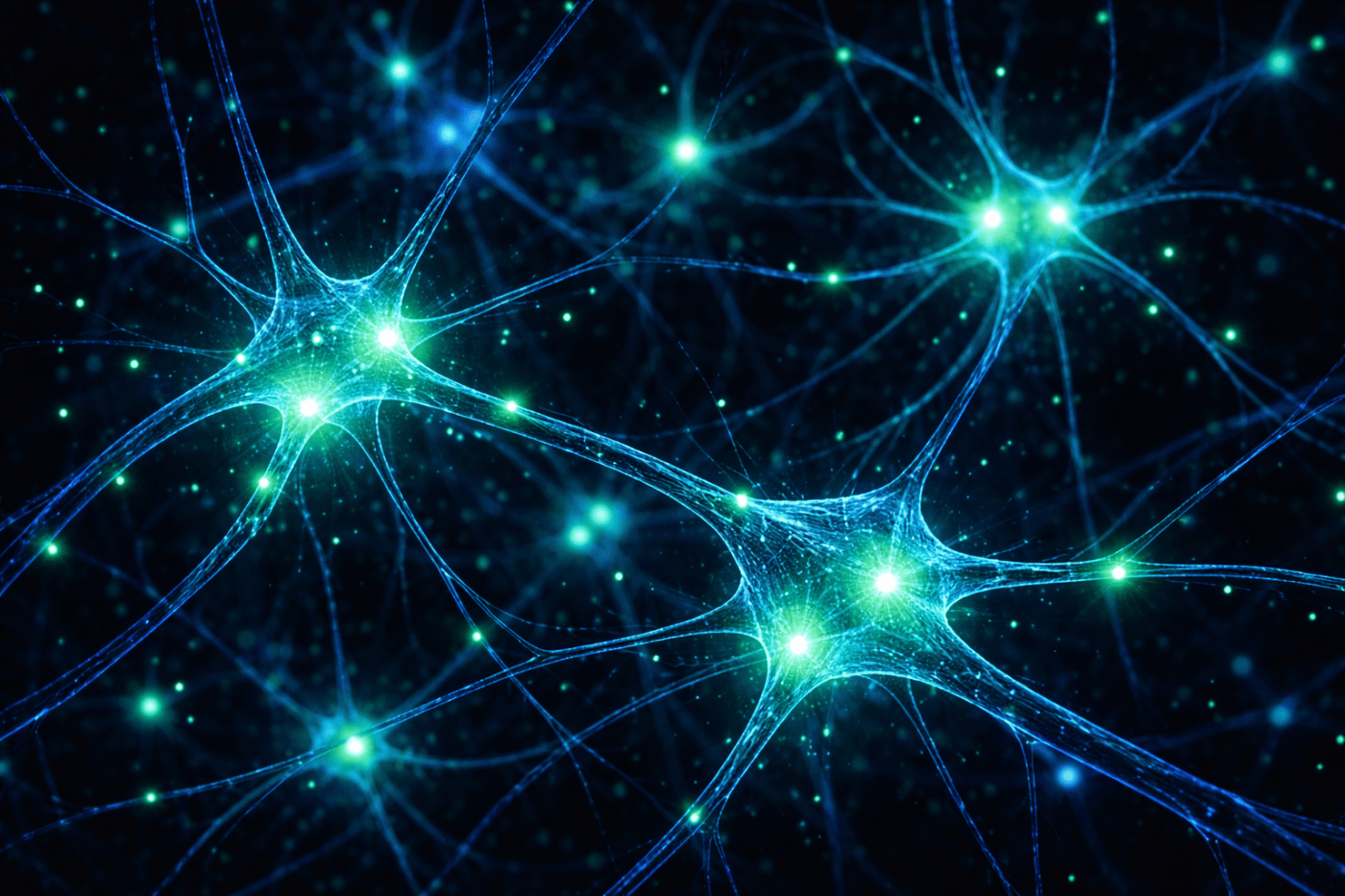
Every thought you have, every memory you hold, every decision you make begins with a whisper, a faint chemical signal passing between two neurons across a gap so small it makes a human hair look like a highway. Until very recently, neuroscience had no way to listen to those whispers. A new study published in Nature Methods by researchers at the Allen Institute and HHMI’s Janelia Research Campus may have just changed that forever.
The Missing Half of the Conversation
The brain’s neurons talk to each other using chemical messengers called neurotransmitters. The most common of these is glutamate, the workhorse of excitatory signaling, deeply involved in learning, memory, and emotion. When a neuron fires, it releases glutamate into a tiny gap called a synapse. The receiving neuron on the other side detects it and decides: do I fire too, or stay quiet?
Here’s the problem: neuroscientists have long been able to measure what neurons send, but not what they receive. The incoming signals are too faint and too fast. It’s like being able to read every outgoing letter from a post office, but never the ones arriving. That missing half of the conversation has been one of the biggest blind spots in modern neuroscience.
Enter iGluSnFR4- A Molecular Eavesdropper
The new tool is a genetically engineered protein sensor called iGluSnFR4 (informally: “glue sniffer”). It is designed to sit on the surface of a neuron and light up, literally fluoresce, the instant glutamate arrives. That flash of light can be captured by a microscope, giving scientists a real-time readout of incoming signals at individual synapses.
Lead author Dr. Kaspar Podgorski of the Allen Institute put it memorably: “It’s like reading a book with all the words scrambled and not understanding the order of the words or how they’re arranged. What we’re doing here is adding the connections between those neurons, and by doing that, we now understand the order of the words on the pages, and what they mean.”
Previous sensors existed, but they lacked the sensitivity to catch the weakest signals or the speed to track rapid-fire synaptic events. iGluSnFR4 overcomes both limitations, making it possible to observe even the quietest inputs to a neuron across thousands of synapses simultaneously.
Why This Matters Beyond the Lab
The implications ripple outward in several directions:
- Brain disorders: Disrupted glutamate signaling has been implicated in Alzheimer’s disease, schizophrenia, autism spectrum disorder, and epilepsy. Being able to precisely measure what’s going wrong at the synapse level could help identify the biological roots of these conditions far earlier.
- Drug development: Pharmaceutical researchers can now test how candidate drugs affect actual synaptic activity in living tissue, not just whether a molecule binds to a receptor in a dish, but whether it changes real neural conversations.
- Understanding computation: Each neuron integrates thousands of inputs before deciding to fire. Watching that integration process in real time gets us closer to understanding how the brain performs the extraordinary feat of cognition.
A New Era of Neural Listening
For decades, neuroscience has been a science of watching neurons shout. We built instruments to record action potentials, map structural connectivity, and trace the broad strokes of brain activity with fMRI. But the brain doesn’t just shout, it murmurs, negotiates, and listens. The decision to fire is not automatic; it emerges from a constant arithmetic of thousands of tiny incoming voices, most of which science has never been able to hear.
iGluSnFR4 is a first real step toward hearing those voices. It won’t solve every mystery in neuroscience overnight. But it gives researchers a window into a layer of brain communication that has been invisible until now, and in science, what you can see, you can eventually understand.
📄 Journal Reference: Podgorski, K. et al. iGluSnFR4: a next-generation glutamate sensor for imaging synaptic inputs in vivo. Nature Methods (2025). nature.com/natmethods
🔗 Full coverage: ScienceDaily — The brain has a hidden language and scientists just found it
 Scents of Science
Leave a comment