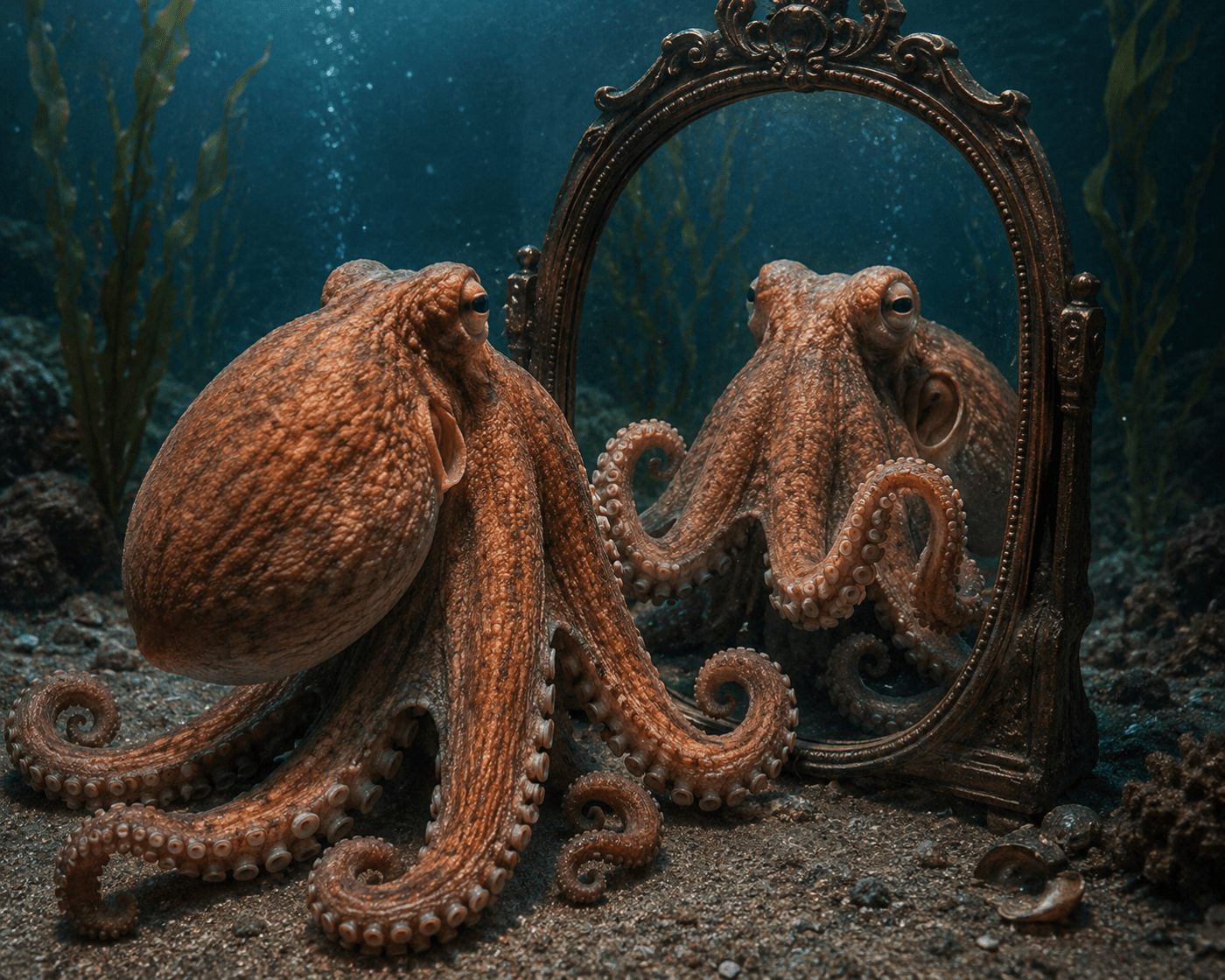
Octopuses have long been known as escape artists and problem-solvers, but a new Dartmouth study adds a striking skill to their résumé: they can use mirrors to locate prey hidden out of their line of sight, a form of spatial cognition previously documented only in vertebrates.
Published in Current Biology, the research trained three California two-spot octopuses to interpret their reflection and infer where a hidden stimulus was located behind them. Rather than lunging at the mirror, the animals learned to make a 180-degree turn and move toward the actual projection site, succeeding on roughly 73% of trials.
“Our findings are the first to demonstrate that invertebrates can use mirrors to understand their environment to find prey,” said lead author Mary Kieseler, who conducted the research as a PhD student at Dartmouth’s Department of Psychological and Brain Sciences. The ability had previously been observed only in certain mammals and birds.
The experimental design was careful about octopus biology: because the animals can smell and taste by touch via chemoreceptors, a virtual crab image was used in place of a live one, with a real crab offered only as a reward upon success. The octopuses were first acclimated to the mirror, then gradually trained to connect what they saw in the reflection with where the target actually was in physical space.
Senior author Peter Tse, a cognitive neuroscientist and professor at Dartmouth, drew a parallel to how new drivers learn to use a rearview mirror, a skill that isn’t instinctive but is learned through experience. Octopuses, it turns out, are capable of the same kind of learning.
The implications reach deeper than a clever lab trick. Octopuses are among the most evolutionarily distant animals from humans, our last common ancestor was a worm that lived 350 to 500 million years ago. That such a remote lineage independently developed mirror-based spatial reasoning hints at convergent evolution: different branches of the tree of life arriving at similar cognitive solutions to similar environmental pressures. The complex, three-dimensional world of coral reefs and ocean floors may favor animals that can build and navigate internal maps of their surroundings.
The researchers note that further work is needed to confirm whether octopuses truly hold a persistent mental map of their territory, but the mirror experiments suggest the architecture for it may already be there.
Source: Kieseler et al., Current Biology (2026) — https://www.cell.com/current-biology/fulltext/S0960-9822(26)00588-9
 Scents of Science
Leave a comment