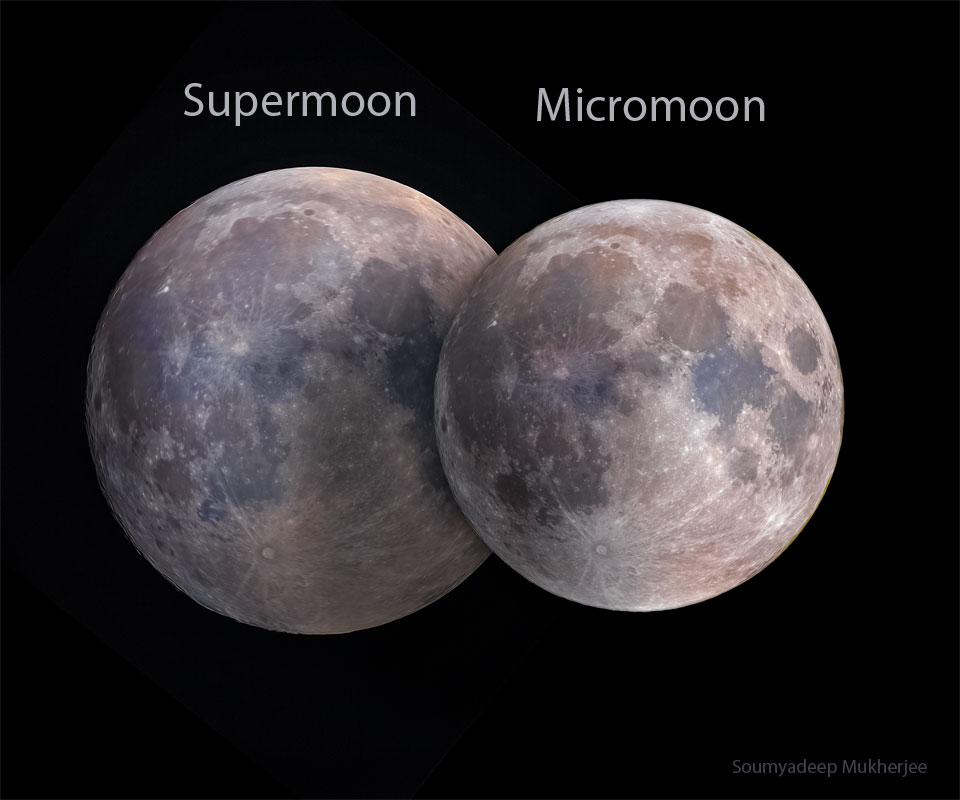
Last night’s full moon was easy to miss, and that was rather the point. While supermoons dominate headlines with their oversized glow, May 30th delivered the opposite: a blue micromoon, the farthest, smallest, and dimmest full moon of the year. NASA featured it as their Astronomy Picture of the Day, showcasing a striking side-by-side comparison photographed from Kolkata, India, one full moon enormous and blazing, the other noticeably smaller and dimmer. Same Moon. Same photographer. Wildly different appearance.
The reason behind that difference is one of the most elegant demonstrations of orbital mechanics visible to the naked eye. And the combination of phenomena that produced last night’s event won’t repeat for nearly three decades.
What Is a Micromoon?
Because the moon does not travel in a perfect circle, its distance from Earth changes slightly throughout each orbit. A micromoon occurs when a full moon coincides with apogee, the point at which the moon is farthest from Earth.
This elliptical orbit is not an accident or anomaly. Johannes Kepler proved in the 17th century with his laws of planetary motion that the Moon’s path around Earth is an ellipse. The consequence is that the Moon swings between a closest point (perigee, roughly 363,300 km away) and a farthest point (apogee, roughly 405,500 km away) every month. As the Moon moves closer to Earth, gravitational potential energy decreases while kinetic energy increases. The opposite occurs as it moves toward apogee. The total energy of the orbit remains constant.
Last night’s moon was approximately 252,360 miles (406,134 km) away from Earth, compared to the average lunar distance of around 238,900 miles (384,472 km). That extra distance made it appear roughly 10–14% smaller and slightly dimmer than a supermoon, a difference most casual observers wouldn’t have noticed without a reference, but one that photographs make unmistakable.
What Made It a Blue Moon?
The “blue” part had nothing to do with colour. A blue moon simply means it is the second full moon in the same calendar month. The first full moon of May rose on the 1st; this one closed out the month on the 30th. The Moon’s orbital period is about 29.5 days, just short of most calendar months, which means occasionally two full moons fit inside a single month, roughly every two to three years.
Neither blue moons nor micromoons are especially rare on their own. What is rare is their coincidence. Although the next micromoon occurs next month, and the next blue moon at the end of 2028, the next blue micromoon will not occur until 2053. Some estimates for observers outside North America push that date even further, to at least December 31, 2066.
If you stepped outside last night and thought the Moon looked like any other full moon, you weren’t wrong, but you were also watching something that won’t happen again in quite this way for a generation.
Why Does This Matter? The Science Behind the Spectacle
Beyond the visual drama, the Moon’s elliptical orbit has real, measurable effects on Earth, and understanding them matters more than most people realise.
Tides. The most immediate consequence of the Moon’s varying distance is gravitational. Once a month at perigee, when the moon is closest to Earth, tide-generating forces are higher than usual, producing above-average tidal ranges. About two weeks later at apogee, the lunar tide-raising force is smaller and tidal ranges are less than average. With last night’s Moon at its most distant, tides were correspondingly subdued. These variations can affect marine life, fishing industries, and coastal erosion over time.
Orbital mechanics in plain sight. What makes supermoon and micromoon comparisons genuinely valuable is that they turn abstract physics into something anyone can see. Kepler’s second law, that an orbiting body sweeps out equal areas in equal times, means the Moon actually moves faster when close to Earth and slower when far away. Last night’s micromoon was the Moon at its most leisurely, ambling through the far arc of its ellipse.
Calibrating our intuitions about the sky. Humans are notoriously poor judges of the Moon’s size. The famous “Moon illusion” makes it appear enormous near the horizon regardless of its actual distance. A micromoon may even seem bigger when rising, due to this optical trick, despite being the smallest-looking moon of the year. Knowing the physics helps us understand why our perception deceives us, which is itself a lesson worth having.
What It Was Not
It’s worth being clear about what a micromoon does not do. Despite persistent claims around supermoons and micromoons alike, there is no scientific evidence linking them to earthquakes, floods, or other natural disasters. The gravitational variation is real but modest, not the stuff of catastrophe, just the quiet, reliable mechanics of an orbit.
The universe doesn’t need special effects to be worth understanding. Sometimes it just needs geometry, and last night, geometry put on quite a show.
Image Credit: Soumyadeep Mukherjee
See the original APOD entry at https://apod.nasa.gov/apod/ap260530.html
 Scents of Science
Leave a comment