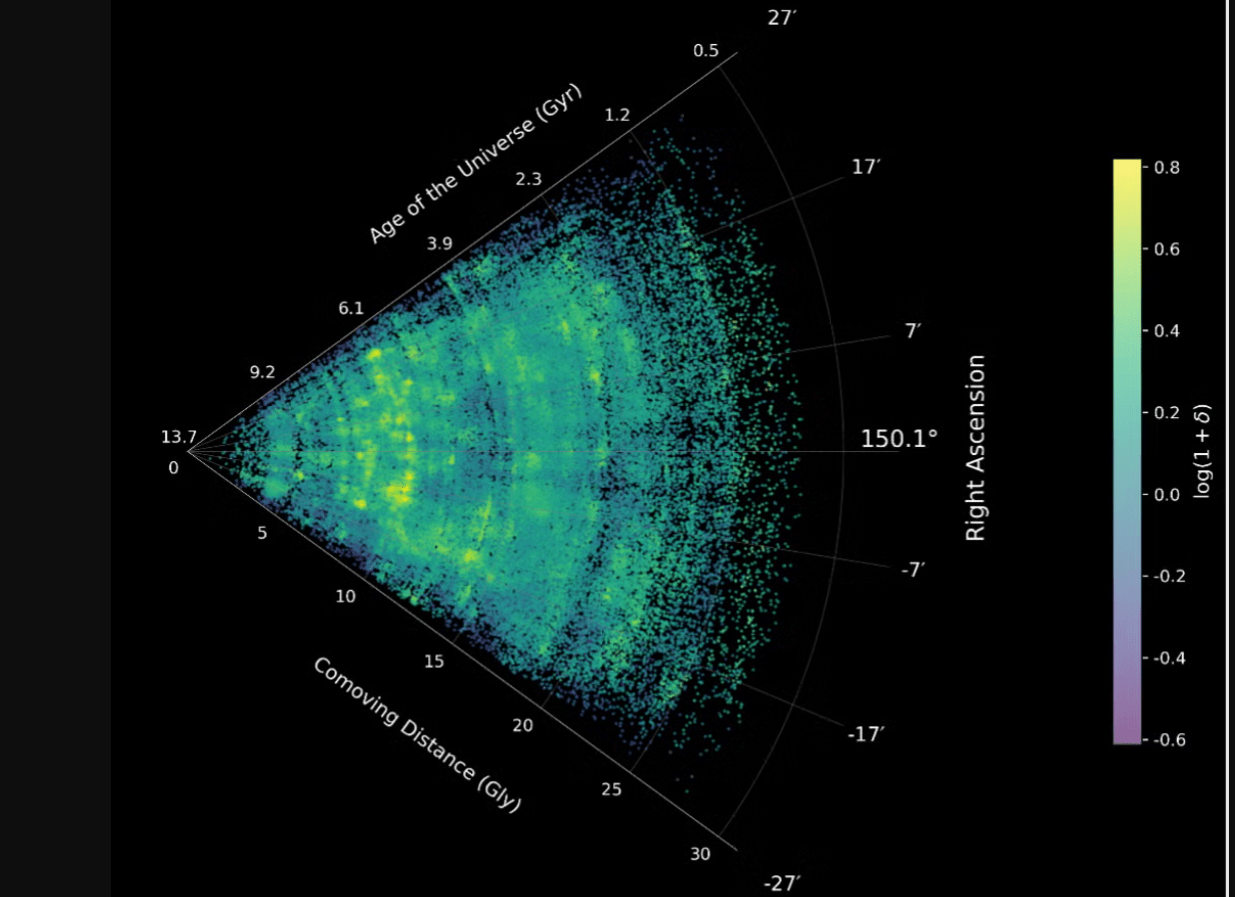
Astronomers have just given us the sharpest picture yet of the universe’s vast, invisible architecture and it’s breathtaking.
Using NASA’s James Webb Space Telescope (JWST), researchers at the University of California, Riverside have produced the most detailed map ever made of the cosmic web, the enormous skeleton-like network of dark matter filaments, gas sheets, and vast empty voids that connects every galaxy in the universe. The findings were published on May 12, 2026, in The Astrophysical Journal.
What is the Cosmic Web?
Think of the universe not as a random scatter of galaxies, but as a vast three-dimensional web. Galaxies and galaxy clusters are strung like beads along enormous filaments of dark matter and gas, separated by immense, nearly empty regions called voids. This cosmic web is the underlying skeleton of everything we can see and much of what we can’t.
What JWST Revealed
The team harnessed the power of COSMOS-Web, the largest observing program ever conducted with JWST. Covering a patch of sky roughly the size of three full Moons, the survey mapped over 164,000 galaxies, placing each one precisely in its slice of cosmic time, stretching all the way back to when the universe was just one billion years old.
Lead author Hossein Hatamnia, a graduate student at UCR and Carnegie Observatories, described what makes this map unprecedented: “For the first time we can study the evolution of galaxies in cluster and filamentary structures across cosmic time, all the way from when the universe was a billion years old up to the nearby universe.”
A Quantum Leap Beyond Hubble
The comparison with previous data from the Hubble Space Telescope is striking. Structures that once looked like single blobs of matter now resolve into multiple distinct features. As Bahram Mobasher, distinguished professor at UCR and the study’s senior author, put it: “The jump in depth and resolution is truly significant, and we can now see the cosmic web at a time when the universe was only a few hundred million years old, an era that was essentially out of reach before JWST.”
Two key strengths of Webb make this possible: it detects far more faint galaxies in the same patch of sky, and it measures the distances to those galaxies with much greater precision placing each one in exactly the right layer of cosmic history.
Open Science for the World
In the spirit of open science, the team has released everything publicly: the full pipeline used to build the map, the catalog of 164,000 galaxies with their cosmic density data, and even a video showing the cosmic web evolving across billions of years. Scientists worldwide can now explore this data themselves.
This is JWST doing what it was built for, not just taking pretty pictures, but fundamentally rewriting our understanding of how the universe is structured and how it came to be.
📄 Journal article: Hatamnia et al. (2026), The Astrophysical Journal, 1002(2):192 https://doi.org/10.3847/1538-4357/ae5bac
Image: A slice through the COSMOS-Web cosmic-web map, showing galaxies across nearly 14 billion years of cosmic history. The vertex on the left marks the present day; moving outward, each galaxy is placed at its distance in cosmic time, reaching back to when the universe was less than a billion years old. Bright yellow regions show the dense clusters and filaments of the cosmic web, while dark regions mark the near-empty voids in between. (UCR/Hossein Hatamnia)
 Scents of Science
Leave a comment