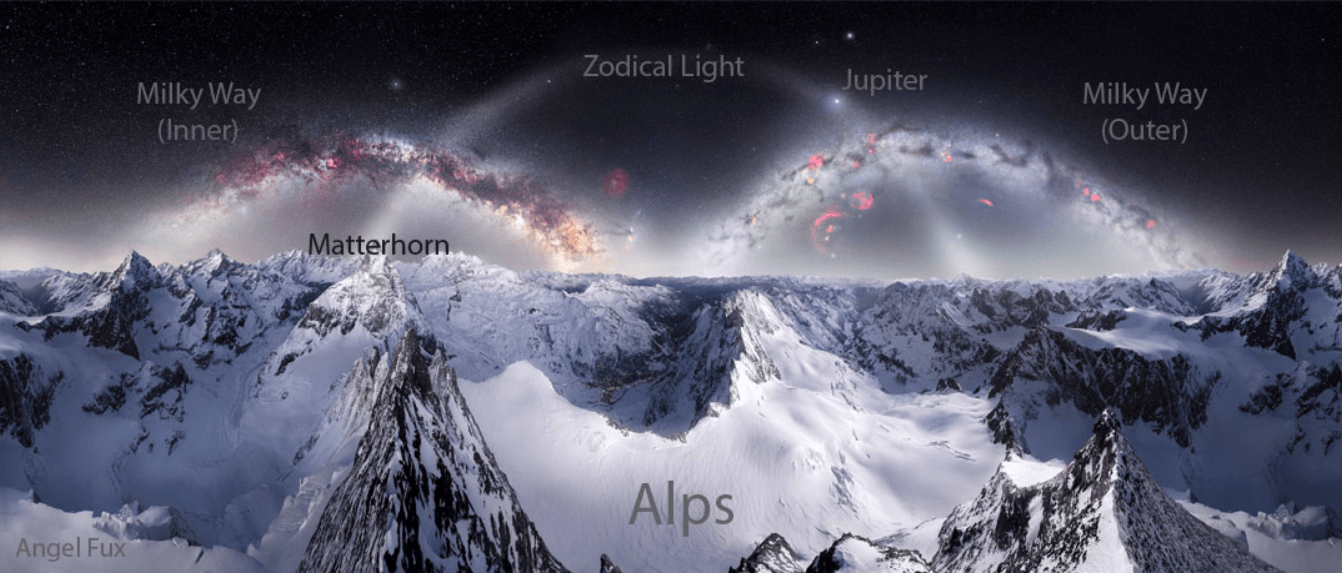
Look up on a perfectly dark night and you might see the spine of the Milky Way curving overhead. Look even harder and with skies dark enough and you might catch something rarer still: three great arches crossing the heavens at once.
That is exactly what greeted an astrophotographer last month after being dropped by helicopter onto a high Alpine peak near the Swiss-Italian border. The result is NASA Astronomy Picture of the Day a breathtaking panorama that is also a quiet lesson in Earth science.
What Are the Three Arches?
Arch 1 – The inner Milky Way. Visible just before sunrise, this is the direction toward the galactic centre in Sagittarius. The bright, dense star-clouds there are packed within about 26,000 light-years of us, and they glow because hundreds of billions of suns are compressed into a relatively small volume of sky. The dark lanes cutting through them are not empty space but cold molecular clouds the nurseries where new stars and, perhaps, new Earths are being assembled right now.
Arch 2 – The outer Milky Way. Visible just after sunset in the opposite direction, this fainter arc traces the spiral arm structure beyond our own Solar System, looking outward toward the galactic rim. Stars here are older, more spread out, and the view stretches toward the Milky Way’s faint halo of ancient globular clusters.
Arch 3 – The zodiacal light. This is the surprise guest and the one that connects most directly to Earth Day. The zodiacal light is sunlight scattered by a vast, lens-shaped cloud of interplanetary dust concentrated in the plane of the Solar System. The dust comes largely from asteroid collisions and comet trails. In the Alps image, this pale pillar of scattered light artfully bridges the two Milky Way arches, linking galactic deep-sky drama to the immediate neighbourhood of our own planet.
The Science of Seeing It
The zodiacal light is notoriously shy. You need skies free of artificial light pollution, something that has become increasingly rare as cities grow and LEDs proliferate. A 2016 study estimated that more than one-third of humanity, and roughly 80% of North Americans, can no longer see the Milky Way from where they live. The fact that an Alpine summit still offers views of all three arches simultaneously is testament to how important dark-sky preservation has become as an environmental goal.
There is also atmospheric science at play. The Alps form one of Europe’s most dramatic land-atmosphere interfaces. Cold dense air pools in the valleys while cleaner, drier air sits above a natural “lens” that reduces atmospheric turbulence and lets starlight travel to the camera with minimal distortion. This is the same physics that drives Alpine weather systems, guides migrating birds, and influences precipitation patterns across the Mediterranean and central Europe.
Earth Day: Looking Down and Looking Up
Earth Day 2026 falls on April 22, today, and the theme, as always, is the fragility and resilience of the only world we know to host life. The three-arch image is a fitting emblem.
The zodiacal dust cloud is a reminder that our Solar System is not pristine. It is constantly being replenished by the grinding of ancient rocky bodies, processes that have been ongoing for 4.6 billion years. Earth itself was assembled from this same reservoir. Every atom of iron in your blood, every molecule of water in the ocean, arrived here via collisions in that dusty disk.
The Milky Way arches put Earth’s timescale in perspective. The light in the outer arch left its stars thousands of years ago. The inner arch carries photons that have been travelling since before recorded human history. Our entire industrial civilisation the source of the carbon emissions now driving climate change occupies a geological eyeblink on this scale.
And yet that eyeblink matters enormously. In planetary terms, humans are a geologically novel force: we now move more sediment than all the world’s rivers combined, we have altered the nitrogen cycle beyond anything the biosphere has seen in 2.5 billion years, and atmospheric CO₂ is higher today than at any point in at least 3 million years.
What the Night Sky Teaches Us
There is something clarifying about standing on a cold Alpine peak at 3 a.m. and watching three great arches wheel overhead. It strips away abstraction. The zodiacal light is not a metaphor, it is actual sunlight, bouncing off actual grains of silicate and carbon dust, entering your actual eye. The Milky Way is not a poster. It is the galaxy you live inside.
When we talk about protecting Earth’s atmosphere from greenhouse gases, we are talking about preserving the thin blue shell, visible in every photograph taken from space, that makes this cosmic coincidence called “life on Earth” possible. The Alpine astrophotographer could see all three arches precisely because the air above those mountains was clean, cold, and dark. That is not guaranteed. It is a choice.
On Earth Day 2026, APOD photo is a quiet invitation: look up to understand how rare this is, then look around to decide what we do with that knowledge.
Image credit: NASA Astronomy Picture of the Day, April 21 2026. View the original and full explanation at apod.nasa.gov.
Image Credit & Copyright: Angel Fux
 Scents of Science
Leave a comment