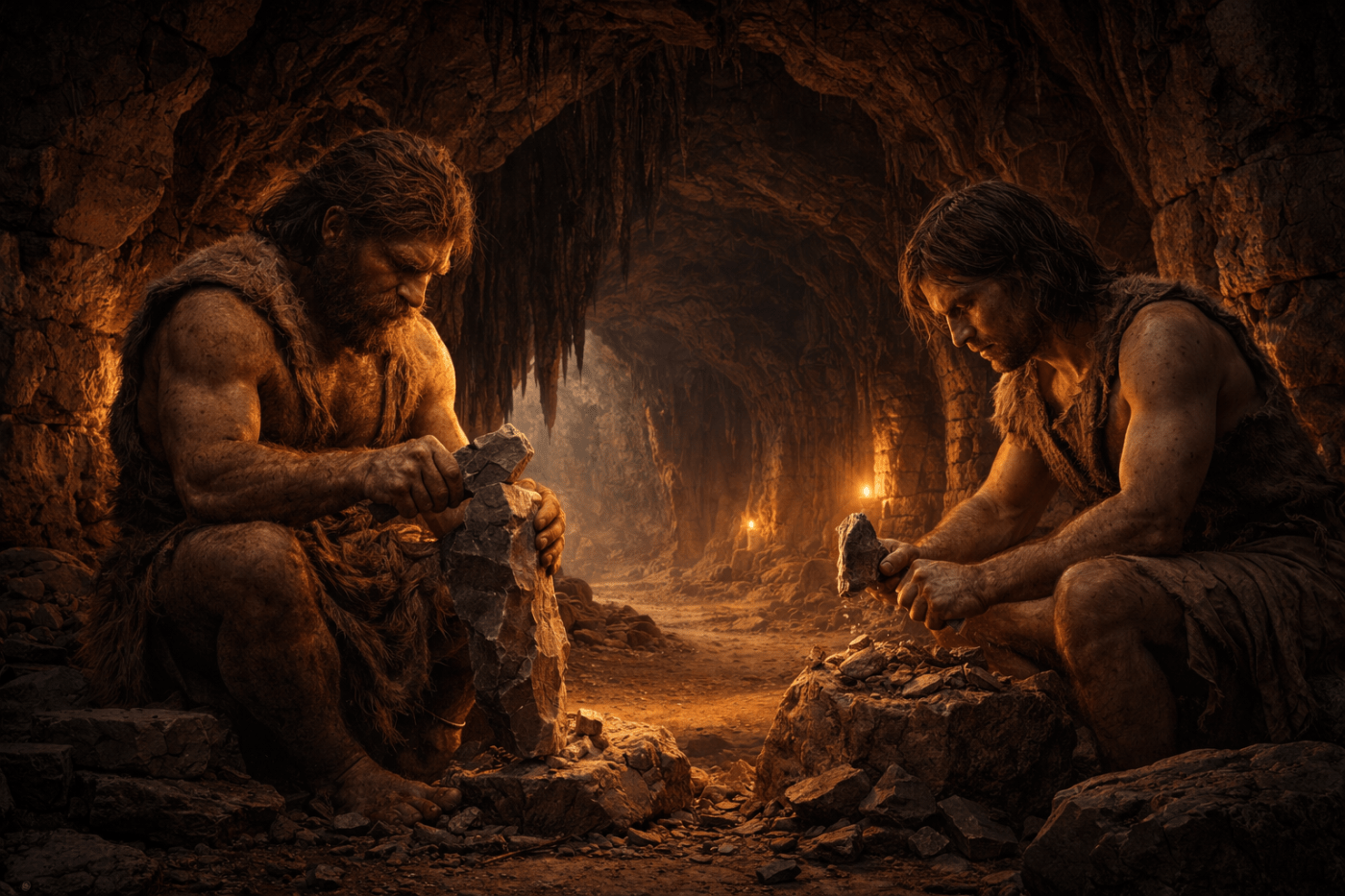
For most of modern history, the story we told about Neanderthals was simple: they were the other guys. Primitive. Separate. Eventually gone, replaced by us Homo sapiens, the smarter, more adaptable species that won the evolutionary race.
A cave in central Israel just tore that story apart.
What They Found
The first-ever published research on Tinshemet Cave reveals that Neanderthals and Homo sapiens in the mid-Middle Paleolithic Levant not only coexisted but actively interacted, sharing technology, lifestyles, and burial customs.
Since 2016, archaeologists working at Tinshemet Cave have uncovered the remains of five early humans dating back around 110,000 to 100,000 years ago, including two full skeletons and three isolated skulls. The cave, a dark crevice in central Israel’s rolling hills, has turned out to be one of the most important sites for understanding human evolution ever discovered.
The burials were in a fetal position, often accompanied by red ochre, and the arrangement closely mirrors what we see at other prehistoric sites like Skhul and Qafzeh caves, suggesting early human populations across the Levant shared cultural traditions.
They Didn’t Just Live Near Each Other, They Learned From Each Other
Stone tools from the site show manufacturing techniques common to all groups, suggesting direct knowledge transfer rather than independent parallel development. In other words, they weren’t just neighbors, they were teachers and students to one another.
The cave also yielded thousands of ochre fragments, some transported from distant sources, indicating deliberate collection rather than incidental use. Ochre, a vivid red-orange mineral pigment is one of the earliest known materials used for symbolic expression. The fact that both species were using it, in the same rituals, in the same place, says something profound about how connected they really were.
The World’s Oldest Cemetery?
The arrangement of burials at the site raises the possibility that Tinshemet Cave served as a dedicated burial area or even an early cemetery. Objects placed alongside the dead, including stone tools, animal bones, and pieces of ochre, may hint at early beliefs about an afterlife.
Formal burial customs began to appear around 110,000 years ago in the Levant, the earliest instances of intentional Homo burials anywhere in the world, predating formalized burial practices in Europe and Africa by tens of thousands of years. And crucially, these rituals didn’t belong to just one species. They were shared.
What This Changes
Lead researcher Prof. Yossi Zaidner of the Hebrew University of Jerusalem describes the region as a “melting pot” where diverse human groups met, interacted, and evolved together. “Our data shows that human connections and population interactions were fundamental in driving cultural and technological innovations throughout history.”
“The mixing of subgroups created opportunities for different groups of primitive humans to exchange knowledge or express their identity. It’s at this time that archaeologists see for the first time examples of primitive jewelry or body painting.”
The old narrative cast Neanderthals and humans as rivals. Tinshemet Cave tells a different story, one where connection, not competition, was the engine of human progress. Where two different kinds of people looked at the same dead and felt the same need to bury them with care, with objects, with meaning.
That instinct, to honor the dead, to mark identity, to pass on knowledge, didn’t belong to us alone.
It was always ours. Together.
Journal article: https://www.nature.com/articles/s41562-025-02110-y
 Scents of Science
Leave a comment