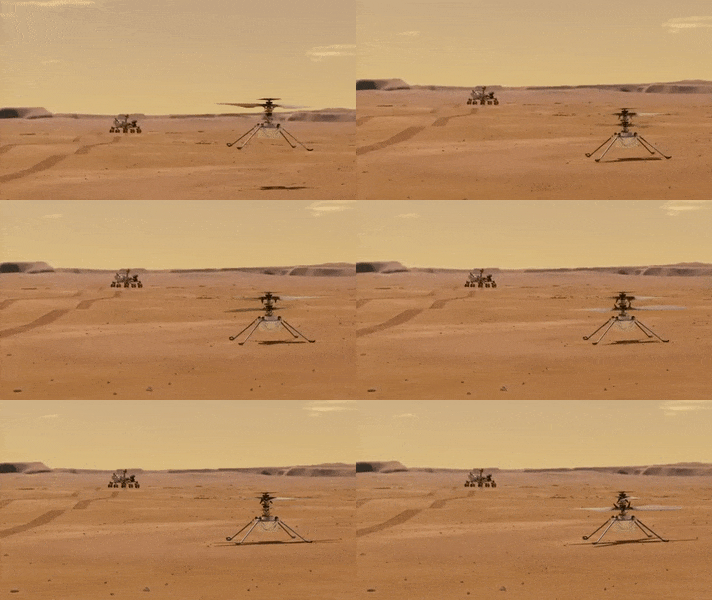
NASA’s Ingenuity helicopter successfully completed its second Mars flight on April 22 – the 18th sol, or Martian day, of its experimental flight test window. Lasting 51.9 seconds, the flight added several new challenges to the first, which took place on... Continue Reading →

What lights up the Flame Nebula? Fifteen hundred light years away towards the constellation of Orion lies a nebula which, from its glow and dark dust lanes, appears, on the left, like a billowing fire. But fire, the rapid acquisition of oxygen, is not what makes this Flame glow. Rather... Continue Reading →

A sea of dark dunes, sculpted by the wind into long lines, surrounds Mars' northern polar cap and covers an area as big as Texas. In this false-color image, areas with cooler temperatures are recorded in bluer tints, while warmer features are... Continue Reading →
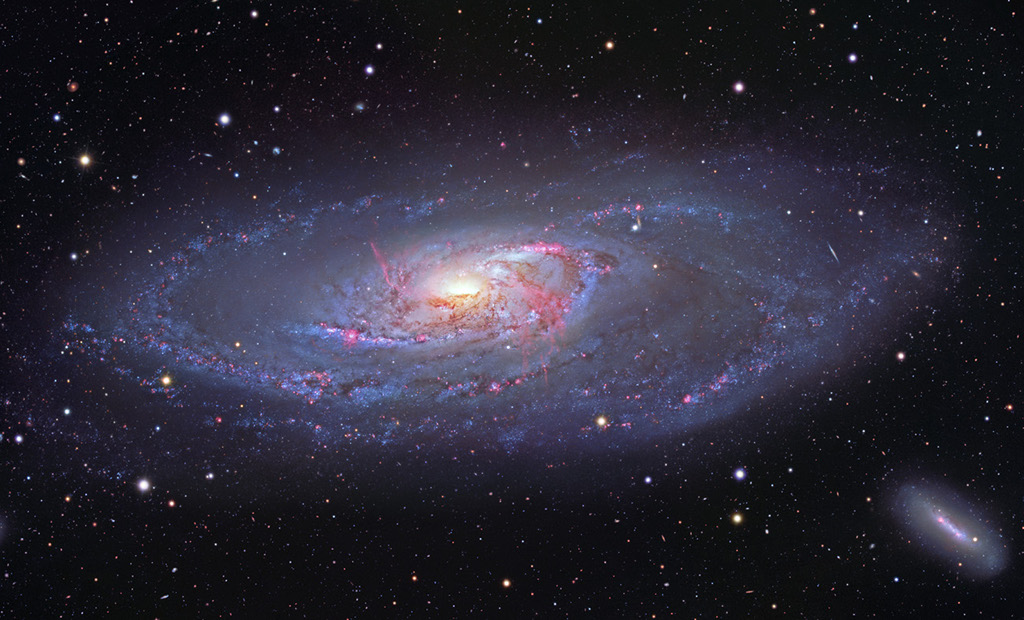
Close to the Great Bear (Ursa Major) and surrounded by the stars of the Hunting Dogs (Canes Venatici), this celestial wonder was discovered in 1781 by the metric French astronomer Pierre Mechain. Later, it was added to the catalog of his friend and colleague Charles Messier as M106. Modern deep... Continue Reading →

The multicolor, stereo imaging Mastcam-Z on the Perseverance rover zoomed in to captured this 3D close-up (get out your red/blue glasses) of the Mars Ingenuity helicopter on mission sol 45, April 5. That's only a few sols before the technology demonstrating Ingenuity will attempt to fly in the... Continue Reading →

Found in far southern skies, deep within the boundaries of the constellation Dorado, NGC 1947 is some 40 million light-years away. In silhouette against starlight, obscuring lanes of cosmic dust thread across the peculiar galaxy's bright central regions. Unlike the rotation... Continue Reading →
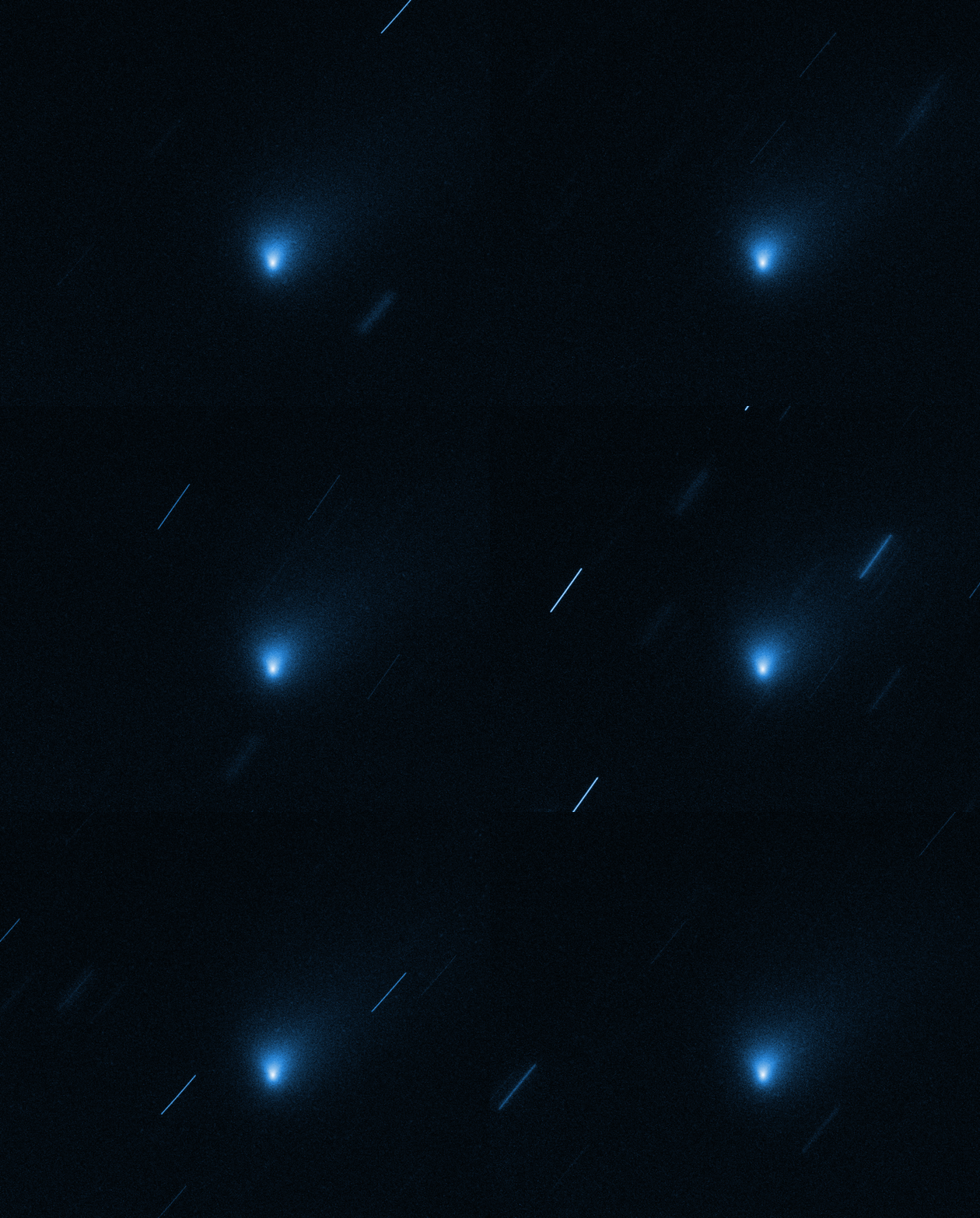
New observations with the European Southern Observatory’s Very Large Telescope (ESO’s VLT) indicate that the rogue comet 2I/Borisov, which is only the second and most recently detected interstellar visitor to our Solar System, is one of the most pristine ever... Continue Reading →

Four moons are visible on the featured image -- can you find them all? First -- and farthest in the background -- is Titan, the largest moon of Saturn and one of the larger moons in the Solar System. The dark feature across the top of... Continue Reading →

ESA’s M-Argo mission will be the first CubeSat to traverse interplanetary space under its own power. Due to launch in 2024-5, the suitcase-sized spacecraft will travel to a near-Earth asteroid, up to 150 million km away. CubeSats are small, cheap satellites assembled... Continue Reading →
 Scents of Science