
Billions of years ago, something slammed into the dark side of the moon and carved out a very, very large hole. Stretching 1,550 miles (2,500 kilometers) wide and 8 miles (13 km) deep, the South Pole-Aitken basin, as the tremendous hole is known... Continue Reading →

For 400 years people have tracked sunspots, the dark patches that appear for weeks at a time on the sun's surface. They have observed but been unable to explain why the number of spots peaks every 11 years. A University... Continue Reading →

The sun and its atmosphere consist of several zones or layers. From the inside out, the solar interior consists of: the Core (the central region where nuclear reactions consume hydrogen to form helium. These reactions release the energy that ultimately leaves the... Continue Reading →

Amid reports that the Russians will keep the cause of an air leak discovered at the International Space Station in 2018 secret, NASA Administrator Jim Bridenstine has promised to speak personally with the head of the Russian space agency. "They have not... Continue Reading →

Neutron stars -- the compressed remains of massive stars gone supernova -- are the densest "normal" objects in the known universe. (Black holes are technically denser, but far from normal.) Just a single sugar-cube worth of neutron-star material would weigh... Continue Reading →

Using radar data from NASA's Cassini spacecraft, recently published research presents a new scenario to explain why some methane-filled lakes on Saturn's moon Titan are surrounded by steep rims that reach hundreds of feet high. The models suggests that explosions... Continue Reading →

A newly discovered comet has excited the astronomical community this week because it appears to have originated from outside the solar system. The object — designated C/2019 Q4 (Borisov) — was discovered on Aug. 30, 2019, by Gennady Borisov at... Continue Reading →
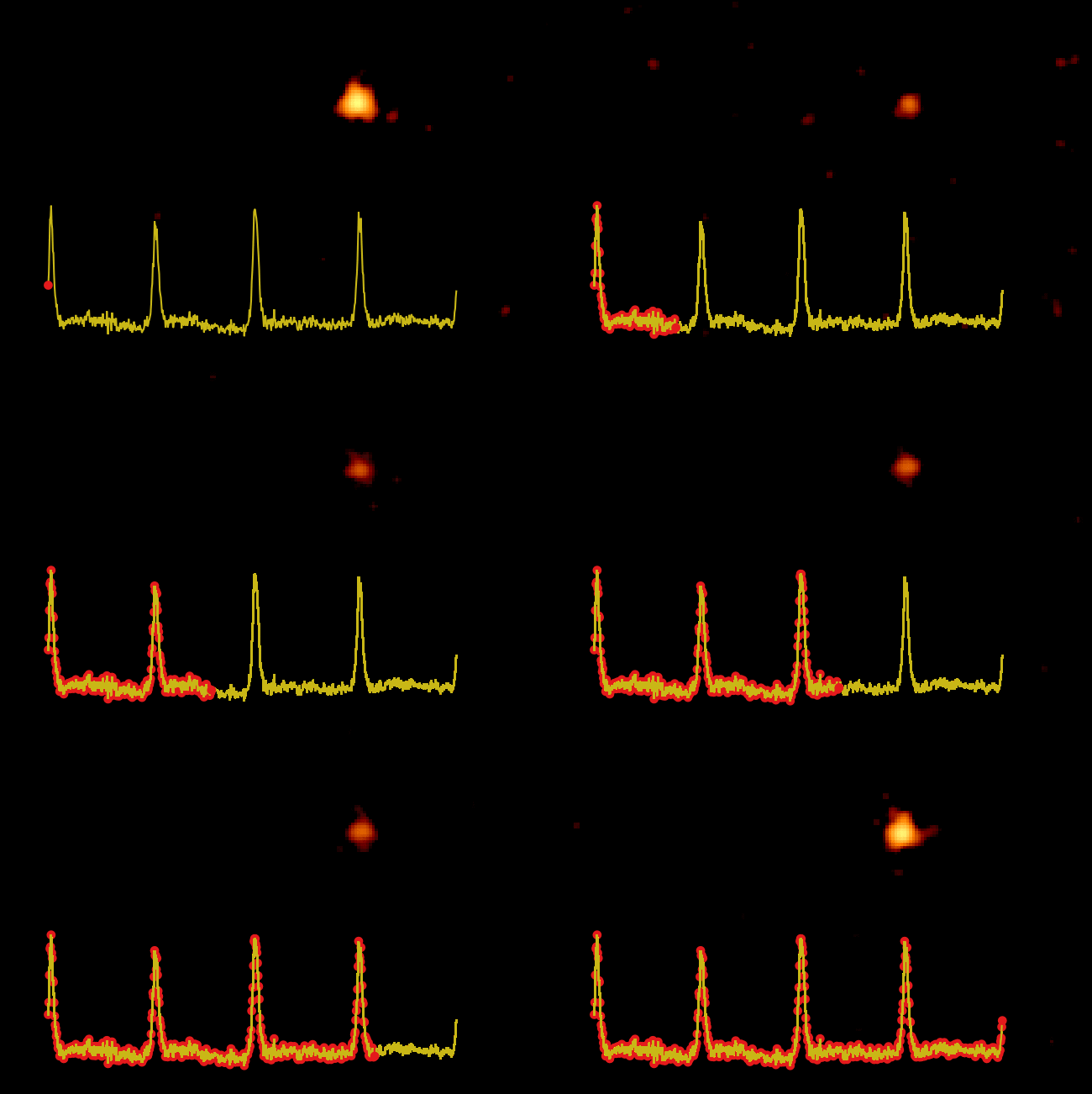
ESA’s X-ray space telescope XMM-Newton has detected never-before-seen periodic flares of X-ray radiation coming from a distant galaxy that could help explain some enigmatic behaviours of active black holes. XMM-Newton, the most powerful X-ray observatory, discovered some mysterious flashes from... Continue Reading →

Ever since the discovery of the first exoplanet in the 1990s, astronomers have made steady progress towards finding and probing planets located in the habitable zone of their stars, where conditions can lead to the formation of liquid water and... Continue Reading →
 Scents of Science