AMHERST, Mass. – A team of physicists, including University of Massachusetts assistant professor Tigran Sedrakyan, recently announced in the journal Nature that they have discovered a new phase of matter. Called the “chiral bose-liquid state,” the discovery opens a new path in the... Continue Reading →

Researchers at QuTech—a collaboration between the Delft University of Technology and TNO—have engineered a record number of six, silicon-based, spin qubits in a fully interoperable array. Importantly, the qubits can be operated with a low error-rate that is achieved with... Continue Reading →

Strong alternating magnetic fields can be used to generate a new type of spin wave that was previously just theoretically predicted. This was achieved for the first time by a team of physicists from Martin Luther University Halle-Wittenberg (MLU). They... Continue Reading →

Excitons are quasiparticles that are formed in insulators or semiconductors when an electron is promoted to a higher energy band, leaving a positively charged hole behind. At the presence of strong Coulomb interaction, electrons and holes (vacancies left by electron... Continue Reading →

Be it magnets or superconductors: materials are known for their various properties. However, these properties may change spontaneously under extreme conditions. Researchers at the Technische Universität Dresden (TUD) and the Technische Universität München (TUM) have discovered an entirely new type... Continue Reading →
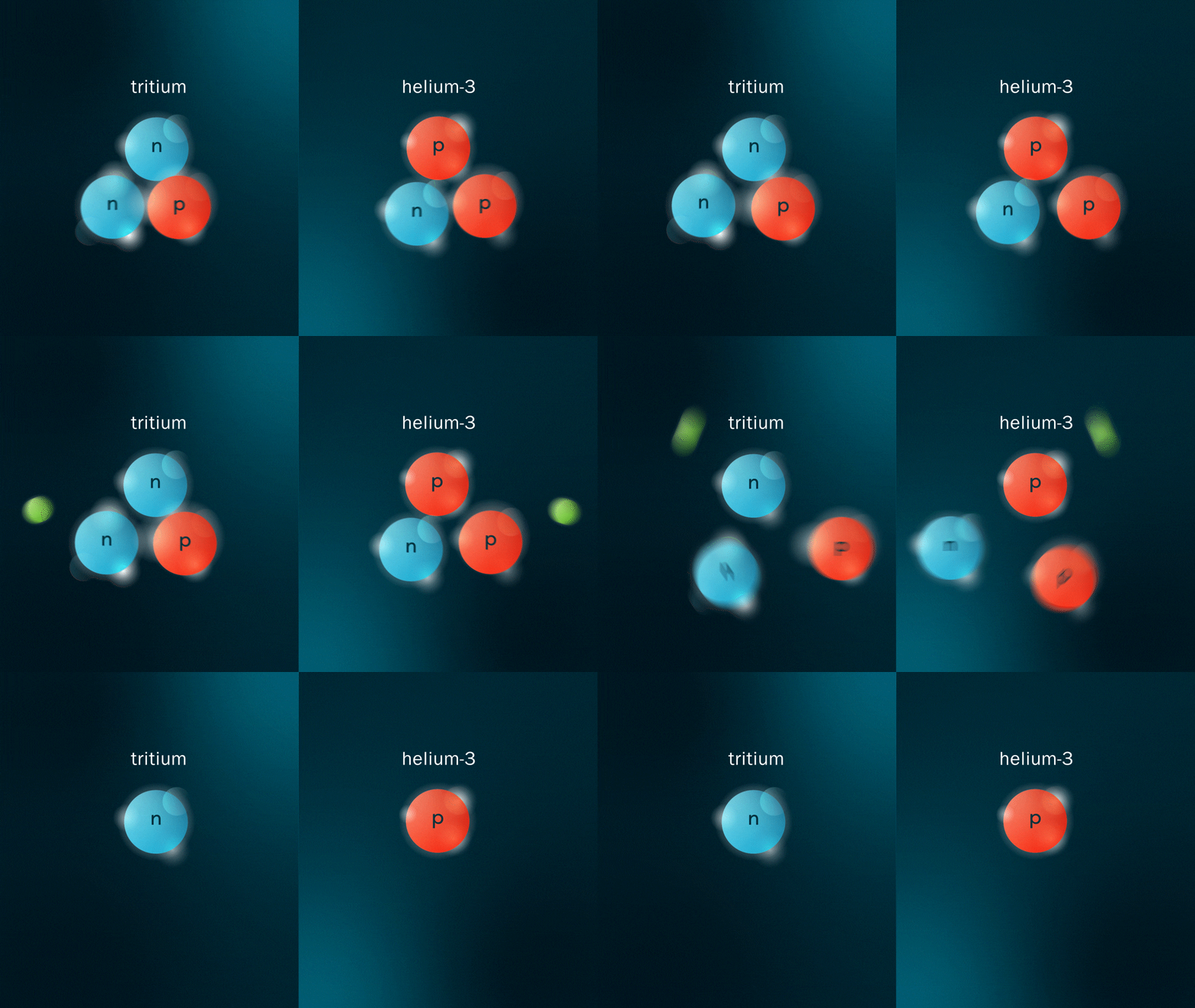
The atomic nucleus is a busy place. Its constituent protons and neutrons occasionally collide, and briefly fly apart with high momentum before snapping back together like the two ends of a stretched rubber band. Using a new technique, physicists studying these... Continue Reading →

New research suggests an unseen 'mirror world' of particles that interacts with our world only via gravity that might be the key to solving a major puzzle in cosmology today -- the Hubble constant problem. The Hubble constant is the... Continue Reading →
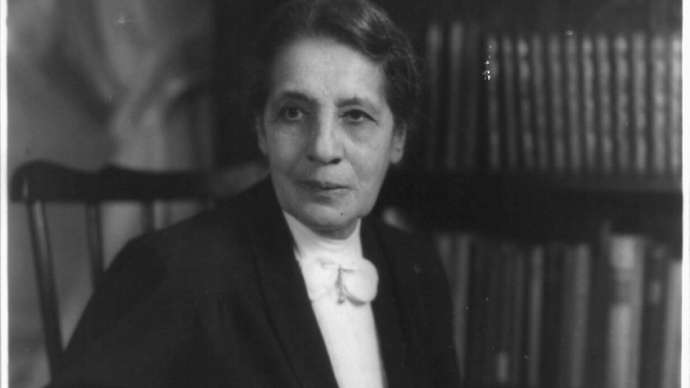
On This Day 1968, Lise Meitner, born November 7, 1878, Vienna, Austria-Hungary [now in Austria] died.Austrian-born physicist who shared the Enrico Fermi Award (1966) with the chemists Otto Hahn and Fritz Strassmann for their joint research that led to the discovery of uranium fission. After receiving her doctorate at... Continue Reading →

Imagine a dust particle in a storm cloud, and you can get an idea of a neutron's insignificance compared to the magnitude of the molecule it inhabits. But just as a dust mote might affect a cloud's track, a neutron... Continue Reading →
 Scents of Science