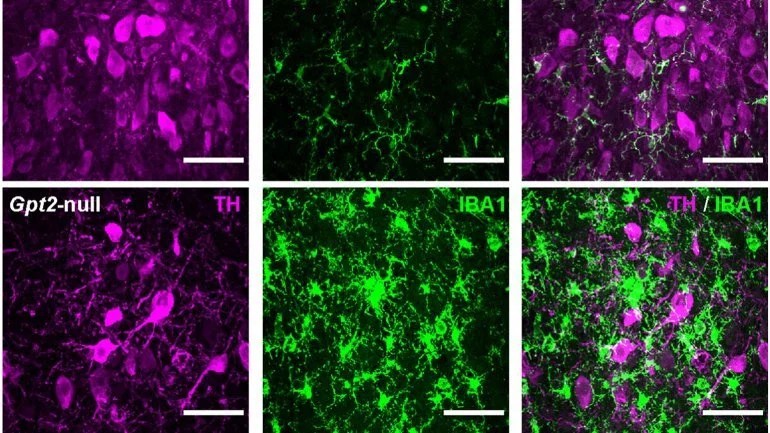
The locus coeruleus is among the first brain regions to degenerate in Alzheimer’s and Parkinson’s disease, physicians and scientists have known. But why this area is so vulnerable is less understood. While continuing their exploration of a rare neurogenetic disorder,... Continue Reading →

Brain cells with the same "birthdate" are more likely to wire together into cooperative signaling circuits that carry out many functions, including the storage of memories, a new study finds. Led by researchers from NYU Grossman School of Medicine, the... Continue Reading →

An international team of scientists has identified the neural mechanisms through which sound blunts pain in mice. The findings, which could inform development of safer methods to treat pain, were published in Science. The study was led by researchers at the... Continue Reading →

A cohort study has found that compared to non-coffee drinkers, adults who drank moderate amounts (1.5 to 3.5 cups per day) of unsweetened coffee or coffee sweetened with sugar were less likely to die during a 7-year follow up period.... Continue Reading →

In a bit of “reverse engineering” research using brain tissues from five people who died with Alzheimer’s disease, Johns Hopkins Medicine researchers say they discovered that a special sugar molecule could play a key role in the development of Alzheimer’s... Continue Reading →

A specially created odor delivery device, along with machine learning-based analysis of scalp-recorded electroencephalogram, has enabled researchers at the University of Tokyo to see when and where odors are processed in the brain. The study found that odor information in... Continue Reading →

Gene editing may be a potential treatment for anxiety and alcohol use disorder in adults who were exposed to binge drinking in their adolescence, according to the results of an animal study published in the journal Science Advances. The study... Continue Reading →

The word sensitivity is thrown around a lot in relation to a number of different things. It can refer both to the senses – that is, our ability to perceive the world around us – or to our tendency to be affected... Continue Reading →
Studying mice, scientists at Washington University School of Medicine in St. Louis have identified a neural circuit and a neuropeptide -- a chemical messenger that carries signals between nerve cells -- that transmit the sensation known as pleasant touch from... Continue Reading →
 Scents of Science