You’ve felt it. Science is finally catching up to explain why.
“Butterflies before a presentation. A knot in your stomach when something’s wrong. Your gut going quiet when you’re deeply focused. We’ve always known the gut reacts to emotions, but what if the signal also travels the other way?”
I’ve noticed it myself. There are days when my digestion is off and my mood follows, not dramatically, not in a way I could easily explain to anyone, but there’s a low-level flatness that arrives with the physical discomfort and leaves with it. For a long time I assumed I was imagining a connection. Turns out I wasn’t. The science has a name for it: the gut-brain axis.
What is the gut-brain axis?
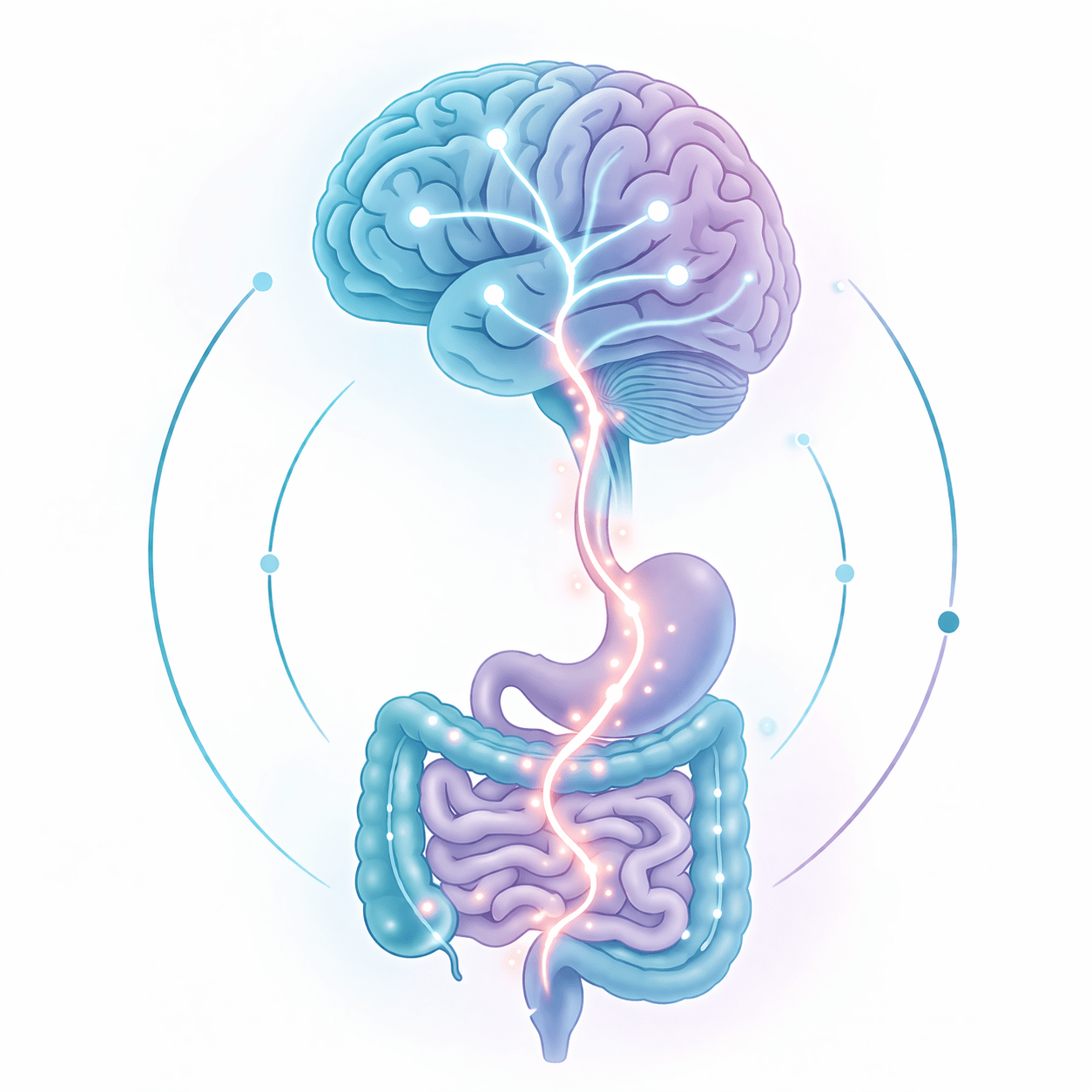
Your gut and your brain are in constant two-way communication through a network of nerves, hormones, and immune signals. The main highway is the vagus nerve, a long, wandering nerve that runs from your brainstem all the way down to your abdomen. What’s surprising is the direction of traffic: roughly 80–90% of the signals on the vagus nerve travel upward, from gut to brain, not the other way around.
Your gut also has its own independent nervous system -the enteric nervous system – containing around 500 million neurons. It can sense, process, and respond to its environment without asking the brain for permission. Some researchers call it the “second brain,” which is catchy but slightly misleading. It’s not thinking. But it is talking.
The serotonin fact that surprises everyone: approximately 90% of your body’s serotonin, the neurotransmitter most associated with mood and wellbeing is produced in the gut, not the brain. It’s made by specialized cells lining the intestinal wall, largely in response to the activity of gut bacteria.
Where do bacteria come in?
Your gut hosts roughly 38 trillion bacteria, about as many as there are human cells in your entire body. This community, called the gut microbiome, is not just along for the ride. It actively produces neurotransmitters, regulates inflammation, and communicates directly with the vagus nerve.
Studies in mice have shown that germ-free animals, raised with no gut bacteria at all display significantly higher stress responses and anxiety-like behavior than normal mice. When researchers transplanted gut bacteria from anxious mice into calm ones, the calm mice became more anxious. The mood transferred with the microbiome. These are animal studies, and humans are more complex, but the signal is hard to ignore.
In humans, research is still catching up. But several studies have found links between microbiome diversity and depression, and at least one randomized controlled trial showed that a specific probiotic combination reduced symptoms of mild-to-moderate depression compared to placebo. The effect sizes are modest — this isn’t a cure — but the direction is consistent.
For a deeper look at how gut inflammation specifically disrupts this connection, Harvard Health has an excellent overview reviewed by immunologist Jun Huh of Harvard Medical School linked here.
My honest take: I don’t think gut health explains everything about mood, and I’m skeptical of anyone selling supplements off the back of this research. But I do think we’ve spent decades treating the brain as if it floats in isolation, completely disconnected from the rest of the body. The gut-brain axis research is a useful correction to that idea. Pay attention to how your body feels, not just your mind. The two are not as separate as we were taught.
3 things you can actually do with this information
- Eat more fiber, more variety. Gut bacteria diversity is consistently linked to better health outcomes. The easiest way to increase it is to eat a wider variety of plants, not just more vegetables, but more different ones. Aim for 30 different plant foods per week. It sounds like a lot until you count herbs, spices, and legumes.
2. Notice the gut-mood connection in yourself. Before reaching for an explanation in your head, ask whether something physical is going on. Poor sleep, poor digestion, and dehydration all affect mood, sometimes before you’re aware of them consciously.
3. Be skeptical of probiotic marketing. The research is real but early. Most commercial probiotics contain strains that haven’t been studied for mood. Fermented foods like yogurt, kefir, sauerkraut, kimchi are a more evidence-consistent choice for microbiome support than most supplements.
The gut-brain axis is one of the most genuinely exciting areas of biology right now, not because it’s solved, but because it’s forcing us to rethink boundaries we assumed were fixed. The brain doesn’t run the body like a CEO sending memos downward. It’s more like a conversation, and your gut has a lot more to say than we ever gave it credit for.
 Scents of Science
Leave a comment