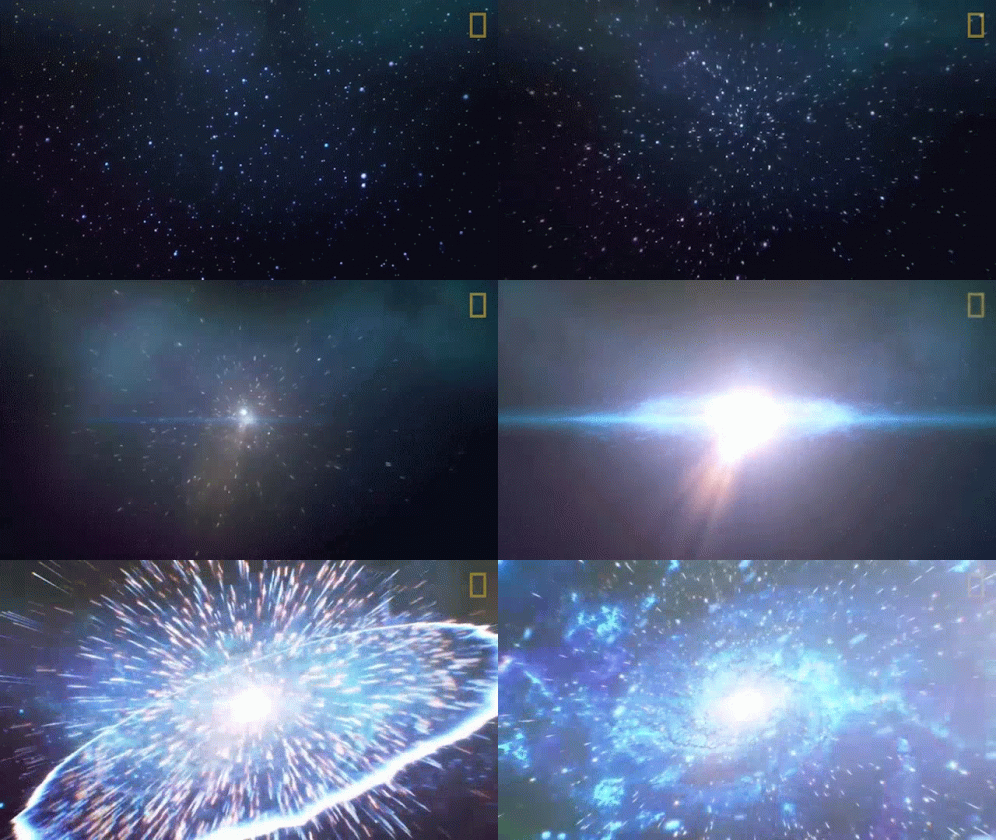
For nearly a century, the Big Bang has been the leading explanation for how our universe began: a hot, dense state that rapidly expanded into everything we see today.
But there’s a problem. When physicists try to rewind the universe all the way back to its first moments, the laws of physics start to break down. The equations that describe gravity—based on Einstein’s theory—simply stop working under such extreme conditions.
Now, researchers at the University of Waterloo think they may have found a better way to understand the universe’s birth—and it could change the picture entirely. Modern cosmology relies heavily on Einstein’s theory of gravity, known as general relativity. It works incredibly well for planets, stars, and galaxies.
But at the moment of the Big Bang?
It fails. That’s because the early universe was unimaginably hot and dense—conditions where quantum physics, the rules governing tiny particles, becomes just as important as gravity.
Bringing these two frameworks together has been one of the biggest unsolved problems in physics.
The Waterloo team tackled this by using a framework called quadratic quantum gravity—a version of gravity that remains mathematically consistent even at extremely high energies.
Instead of patching together different theories (as many current models do), this approach tries to explain everything—from the earliest moments of the universe to today—within a single, unified system.
And here’s the surprising part:
The Big Bang’s rapid expansion may not need extra explanations at all.
One of the key ideas in cosmology is inflation—a brief period when the universe expanded extremely fast right after the Big Bang. Most models need to introduce special fields or assumptions to make inflation work.
But in this new theory: Inflation emerges naturally from gravity itself.
No extra ingredients. No fine-tuning
Just the physics of gravity behaving consistently at extreme energies.
Here’s what makes this theory especially exciting: it’s not just abstract math—it makes real, testable predictions.
The model predicts a minimum level of primordial gravitational waves—tiny ripples in spacetime produced in the universe’s earliest moments.
If future experiments detect these signals, it could be direct evidence that:
- Quantum gravity shaped the birth of the universe
- This new model is on the right track
That’s rare in theoretical physics—especially in something as elusive as the Big Bang.
Traditionally, scientists have had to “patch” Big Bang models with additional assumptions to make them match observations.
This new framework flips that idea:
- Instead of adding complexity
- It simplifies the origin story
The universe’s explosive beginning may not be something that needs to be forced into the equations—it might be a natural consequence of deeper physical laws. If this theory holds up, it could do more than tweak our understanding of the Big Bang.
It could help solve one of the biggest mysteries in physics: how gravity and quantum mechanics fit together. And that’s a big deal—because unifying those two is key to understanding everything from black holes to the structure of spacetime itself.
The early universe has always been a kind of blind spot in science—a place where our best theories stop working.
But this new research suggests something powerful: The beginning of the universe might not be as mysterious or as messy as we thought.
Instead, it could be the natural result of deeper, elegant laws we’re only just beginning to understand.
Source: https://uwaterloo.ca/news/media/new-theory-reshapes-quantum-view-big-bang
Journal article: https://journals.aps.org/prl/abstract/10.1103/6gtx-j455
 Scents of Science
Leave a comment