This month, Venus dazzles as the “Evening Star,” Jupiter reaches its brightest for the year, and the Geminid meteor shower peaks under challenging moonlit skies.
Skywatching Highlights
All Month – Planet Visibility:
- Mercury: Visible very low in the southeast just before sunrise during the last half of the month.
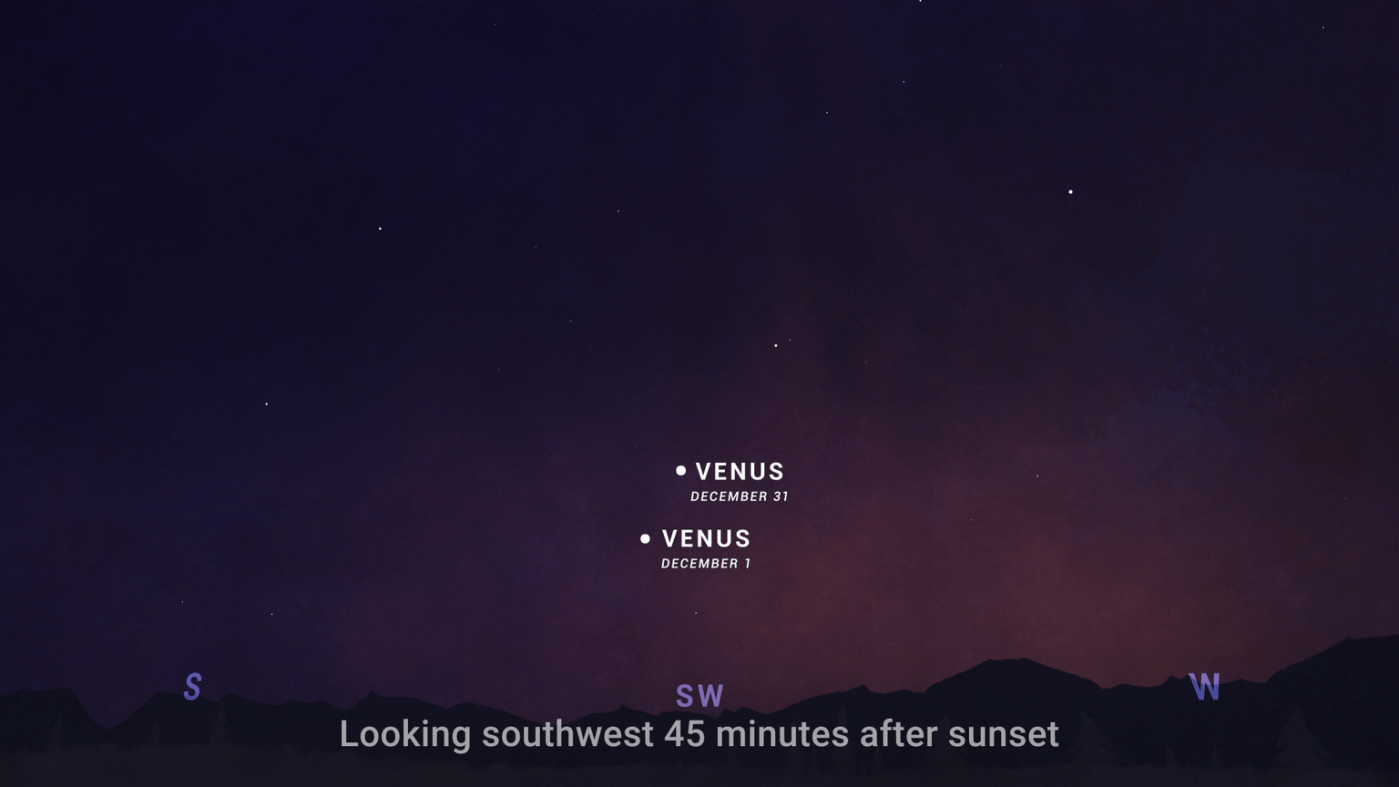
- Venus: Shines brightly as the “Evening Star” in the southwest after sunset, climbing higher each evening.
- Mars: Brightens significantly during December, rising in the east-northeast and visible from late evening to early morning.
- Jupiter: Reaches opposition on December 7, making it visible all night, rising in the east-northeast.
- Saturn: Visible after sunset in the southern sky, shifting slightly westward as the month progresses.
December 3-5 – Venus and the Moon: Look southwest after sunset to see a beautiful pairing. On December 4, a slim crescent Moon will sit directly below Venus.
December 7 – Jupiter at Opposition: Jupiter will shine at its brightest for the year, rising in the east-northeast among Taurus’s stars. Best viewed through a telescope for details like the Galilean moons and atmospheric belts.
December 14 – Jupiter, the Moon, and Aldebaran: Look for Jupiter midway between the nearly full Moon and bright orange star Aldebaran in the evening sky.
December 17 – Mars and the Moon: Mars, glowing brightly in its approach to opposition, appears super close to the waning gibbous Moon.
All Month – Winter Triangle: Formed by Sirius, Procyon, and Betelgeuse, this asterism marks the arrival of winter skies and is a prominent feature throughout the season.
December 13-14 – Geminid Meteor Shower: The peak occurs under a nearly full Moon, reducing visibility, but bright meteors may still be spotted the week before.
December 21 – Winter Solstice: At 4:20 a.m. EST, the solstice marks the beginning of winter in the Northern Hemisphere and summer in the Southern Hemisphere.
Source: NASA
 Scents of Science
Leave a comment