
Astronomers have observed directly for the first time how intense light from stars can ‘push’ matter. Researchers from the universities of Cambridge and Sydney made the observation when tracking a giant plume of dust generated by the violent interactions between... Continue Reading →

This is the last complete image of the asteroid Dimorphos, as seen by our Double Asteroid Redirection Test (DART) two seconds before impact. The Didymos Reconnaissance and Asteroid Camera for Optical navigation (DRACO) imager aboard captured a 100-foot-wide patch of the asteroid.... Continue Reading →
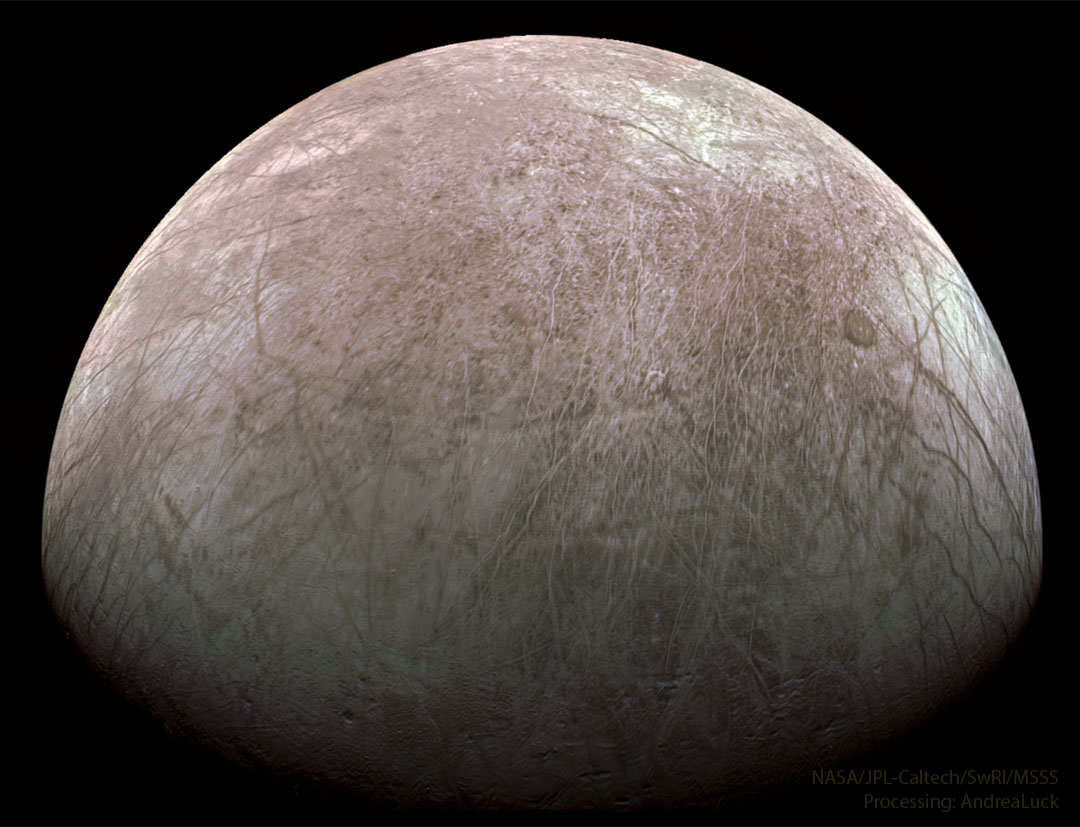
What mysteries might be solved by peering into this crystal ball? In this case, the ball is actually a moon of Jupiter, the crystals are ice, and the moon is not only dirty but cracked beyond repair. Nevertheless, speculation is rampant that... Continue Reading →
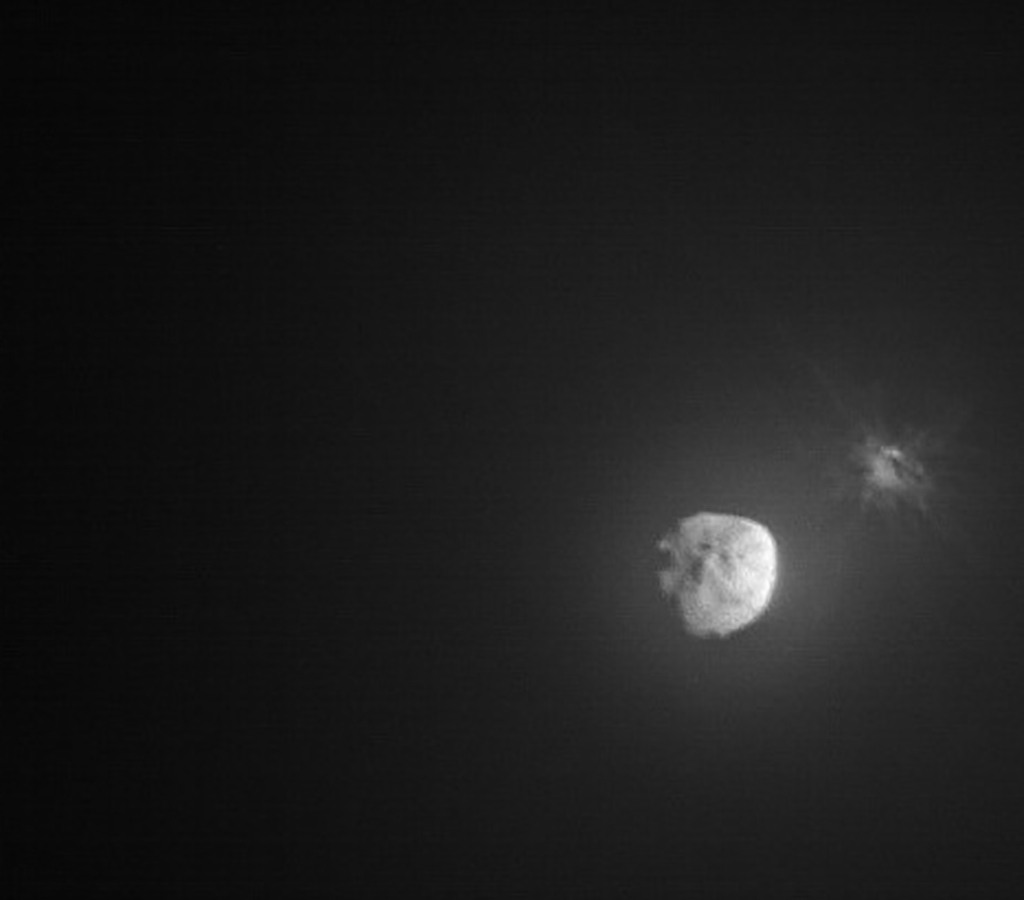
Fifteen days before impact, the DART spacecraft deployed a small companion satellite to document its historic planetary defense technology demonstration. Provided by the Italian Space Agency, the Light Italian CubeSat for Imaging Asteroids, aka LICIACube, recorded this image of the event's aftermath. A cloud... Continue Reading →

On Thursday, Sept. 29, at 2:36 a.m. PDT (5:36 a.m. EDT), NASA’s Juno spacecraft will come within 222 miles (358 kilometers) of the surface of Jupiter’s ice-covered moon, Europa. The solar-powered spacecraft is expected to obtain some of the highest-resolution... Continue Reading →

How much of planet Earth is made of water? Very little, actually. Although oceans of water cover about 70 percent of Earth's surface, these oceans are shallow compared to the Earth's radius. The featured illustration shows what would happen if all of the water on or near the... Continue Reading →

Ringed, ice giant Neptune lies near the center of this sharp near-infrared image from the James Webb Space Telescope. The dim and distant world is the farthest planet from the Sun, about 30 times farther away than planet Earth. But in the stunning... Continue Reading →

Big, beautiful spiral galaxy NGC 7331 is often touted as an analog to our own Milky Way. About 50 million light-years distant in the northern constellation Pegasus, NGC 7331 was recognized early on as a spiral nebula and is actually one of the brighter galaxies not included in... Continue Reading →

The Perseverance rover's Mastcam-Z captured images to create this mosaic on August 4, 2022. The car-sized robot was continuing its exploration of the fan-shaped delta of a river that, billions of years ago, flowed into Jezero Crater on Mars. Sedimentary rocks preserved... Continue Reading →
 Scents of Science