
What happens after a star explodes? A huge fireball of hot gas shoots out in all directions. When this gas slams into the existing interstellar medium, it heats up so much it glows. Two different supernova remnants (SNRs) are visible in the featured image,... Continue Reading →

https://www.youtube.com/watch?v=B1R3dTdcpSU&t=60s Have you ever seen a rocket launch -- from space? A close inspection of the featured time-lapse video will reveal a rocket rising to Earth orbit as seen from the International Space Station (ISS). The Russian Soyuz-FG rocket was launched in November 2018 from the Baikonur Cosmodrome in Kazakhstan,... Continue Reading →

Earth's orbit around the Sun is not a circle, it's an ellipse. The point along its elliptical orbit where our fair planet is closest to the Sun is called perihelion. This year perihelion is today, January 4, at 13:28 UTC, with... Continue Reading →
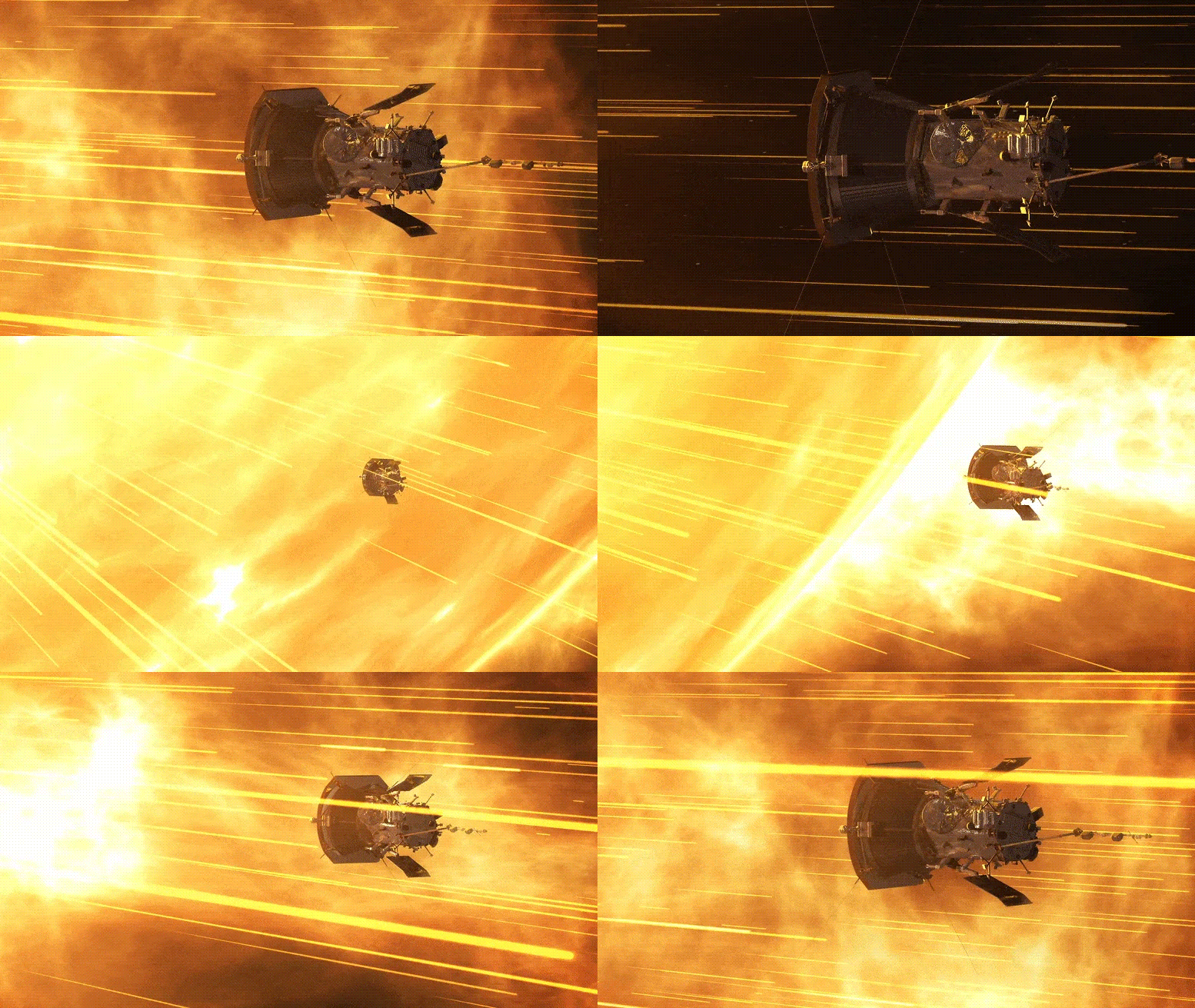
Operations teams have confirmed NASA’s mission to “touch” the Sun survived its record-breaking closest approach to the solar surface on Dec. 24, 2024. Breaking its previous record by flying just 3.8 million miles above the surface of the Sun, NASA’s... Continue Reading →

What excites the Heart Nebula? First, the large emission nebula on the upper left, catalogued as IC 1805, looks somewhat like a human heart. The nebula glows brightly in red light emitted by its most prominent element, hydrogen, but this long-exposure image was also blended with light... Continue Reading →

This kilometer high cliff occurs on the surface of a comet. It was discovered on the dark nucleus of Comet Churyumov - Gerasimenko (CG) by Rosetta, a robotic spacecraft launched by ESA, which orbited the comet from 2014 to 2016. The ragged cliff, as featured here, was imaged... Continue Reading →

New radio astronomy observations of a planetary system in the process of forming show that once the first planets form close to the central star, these planets can help shepherd the material to form new planets farther out. In this... Continue Reading →

Awkward and angular looking, Apollo 17's lunar module Challenger was designed for flight in the near vacuum of space. Digitally enhanced and reprocessed, this picture taken from Apollo 17's command module America shows Challenger's ascent stage in lunar orbit. Small reaction control thrusters are at... Continue Reading →

An intriguing pair of interacting galaxies, M51 is the 51st entry in Charles Messier's famous catalog. Perhaps the original spiral nebula, the large galaxy with whirlpool-like spiral structure seen nearly face-on is also cataloged as NGC 5194. Its spiral arms and dust lanes sweep in... Continue Reading →
 Scents of Science