
Are stars still forming in the Milky Way's satellite galaxies? Found among the Small Magellanic Cloud's (SMC's) clusters and nebulas, NGC 346 is a star forming region about 200 light-years across, pictured here in the center of a Hubble Space Telescope image. A satellite galaxy of the Milky... Continue Reading →

While appearing as a delicate and light veil draped across the sky, this image from the NASA/ESA Hubble Space Telescope actually depicts a small section of the Cygnus supernova blast wave, located around 2,400 light-years away. The name of the supernova remnant comes from... Continue Reading →
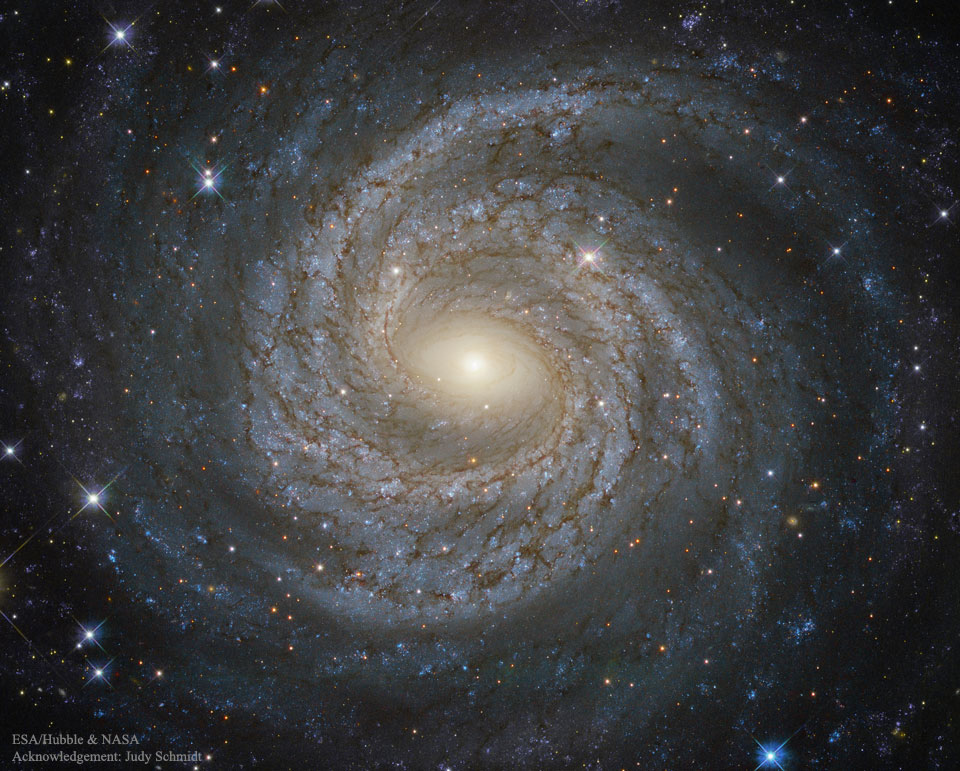
In the center of this serene stellar swirl is likely a harrowing black-hole beast. The surrounding swirl sweeps around billions of stars which are highlighted by the brightest and bluest. The breadth and beauty of the display give the swirl... Continue Reading →

This 2018 composite of the Crab Nebula was made with data from the Chandra X-Ray Observatory (blue and white), Hubble Space Telescope (purple), and Spitzer Space Telescope (pink). The star that exploded to create the Crab Nebula was first seen from Earth in 1054 A.D. Since its launch in 1999,... Continue Reading →

Dark matter, although invisible, makes up most of the universe’s mass and creates its underlying structure. Dark matter’s gravity drives normal matter (gas and dust) to collect and build up into stars and galaxies. Although astronomers cannot see dark matter, they can... Continue Reading →
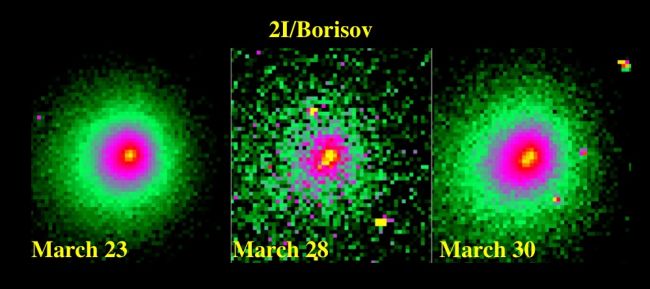
Our solar system's second known interstellar visitor doesn't seem to be in one piece anymore. Photos of the interstellar Comet Borisov taken by NASA's Hubble Space Telescope on March 28 and March 30 show an elongated nucleus that appears to have two... Continue Reading →

This remarkable spiral galaxy, known as NGC 4651, may look serene and peaceful as it swirls in the vast, silent emptiness of space, but don’t be fooled — it keeps a violent secret. It is believed that this galaxy consumed another... Continue Reading →
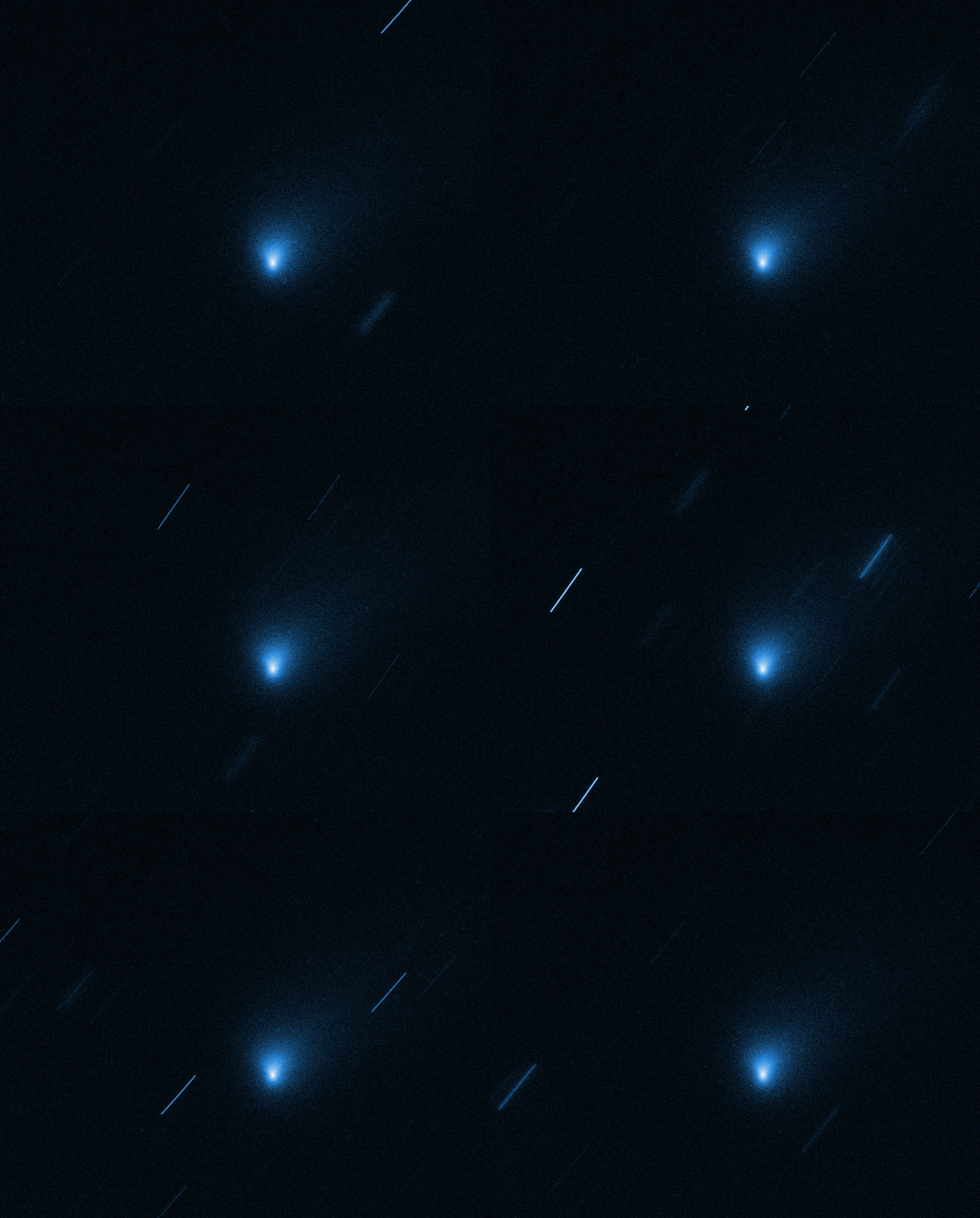
NASA's Hubble Space Telescope has given astronomers their best look yet at an interstellar visitor — comet 2I/Borisov — whose speed and trajectory indicate it has come from beyond our solar system. This Hubble image, taken on Oct. 12, 2019,... Continue Reading →

Is this galaxy jumping through a giant ring of stars? Probably not. Although the precise dynamics behind the featured image is yet unclear, what is clear is that the pictured galaxy, NGC 7714, has been stretched and distorted by a recent collision with a... Continue Reading →
 Scents of Science