
While turbulence is everywhere – from planes to white water rafting and whirlpools in the bathtub – it’s one of the least understood phenomena in physics. The image above is of vortex cannons firing in a 75-gallon aquarium to produce... Continue Reading →

In a study of Americans over age 50 years who died between 2004 and 2014, individuals who were characterized as lonely based on survey results were burdened by more symptoms and received more intense end-of-life care compared with non-lonely people.... Continue Reading →
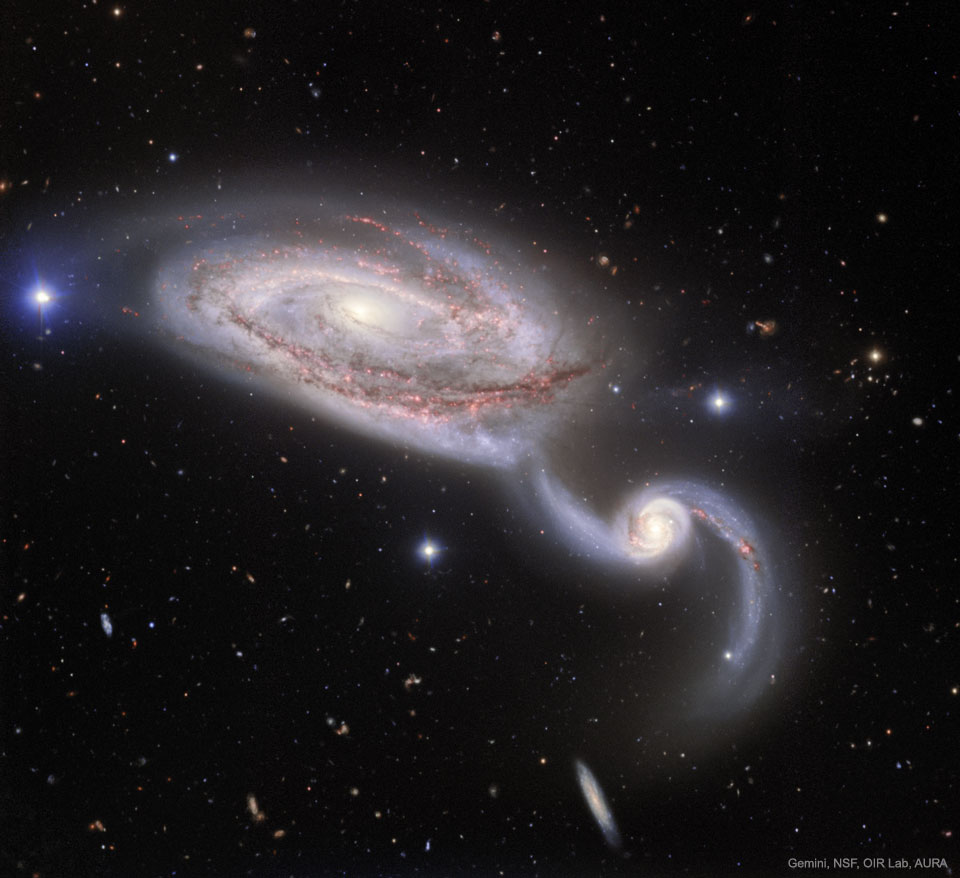
If you like slow dances, then this may be one for you. A single turn in this dance takes several hundred million years. Two galaxies, NGC 5394 and NGC 5395, slowly whirl about each other in a gravitational interaction that sets off a flourish... Continue Reading →

The Earth of 3.2 billion years ago was a "water world" of submerged continents, geologists say after analyzing oxygen isotope data from ancient ocean crust that's now exposed on land in Australia. And that could have major implications on the... Continue Reading →

Blown by fast winds from a hot, massive star, this cosmic bubble is much larger than the dolphin it appears to be. Cataloged as Sharpless 2-308 it lies some 5,200 light-years away toward the constellation of the Big Dog (Canis Major) and... Continue Reading →

Rats on a high sugar diet during pregnancy have altered levels of sex steroid hormones (e.g. progesterone) and dopamine in their brains, which may lead to behavioural changes that can affect care of offspring and motivation, as well as increasing... Continue Reading →

University students and researchers working on a NASA mission orbiting a near-Earth asteroid have made an unexpected detection of a phenomenon 30 thousand light years away. Last fall, the student-built Regolith X-Ray Imaging Spectrometer (REXIS) onboard NASA’s OSIRIS-REx spacecraft detected... Continue Reading →

Oxytocin, a brain peptide that is widely known for its role in love and bonding, may hold potential for helping individuals overcome alcohol addiction. In a collaborative study with the National Institute on Drug Abuse (NIDA), scientists at Scripps Research... Continue Reading →

In 46 BC Julius Caesar reformed the calendar system. Based on advice by astronomer Sosigenes of Alexandria, the Julian calendar included one leap day every four years to account for the fact that an Earth year is slightly more than 365 days long.... Continue Reading →
 Scents of Science